
Defining reliable and productive processes within a company is no easy task. It requires aligning internal expectations, user demands, and market competitiveness while also considering product or service quality. The good news is that there's a solution. You just need to understand what Six Sigma is and the benefits its implementation brings to the company. In this post, we'll explain in detail what Six Sigma is, the advantages of its implementation, and the steps this methodology covers. Interested in learning more? Then keep reading and find out!
Also known in Portuguese as Seis Sigma, it is a set of practices aimed at eliminating or reducing nonconformities in a company's processes. It is a technique developed in 1987 by Bill Smith, a former Motorola engineer. Bill sought to maximize the company's performance by eliminating internal defects and maintaining the established standards of compliance. A few years later, the method had already become popular due to its use in other major multinational companies, such as General Electric (GE), for example. Six Sigma can be understood as a management strategy method focused on quality and financial results. Furthermore, it aims to promote significant changes in organizations, improving internal processes, products, and services offered. It is always seeking customer satisfaction through defect reduction and increased process performance. Sigma is a Greek letter that in statistics represents the standard deviation. When it comes to quality, sigma represents the amount of variation in a process. The greater the variation in this process, the worse the quality and the lower the sigma level of that process. Let's consider, for example, a company that manufactures parts for airplanes. Let's assume that 1 million parts are produced in a year. If, among those 1 million parts, 690,000 have some defect, this means that only about 31% of the parts produced meet the quality requirements. With this percentage, we say that this process is sigma level 1. Imagine you are on a plane where the parts produced by a sigma level 1 process (that is, only about 31% were defect-free). I suspect you wouldn't get on that plane. Now let's consider the other extreme. Out of 1 million parts produced, only slightly more than 3 parts had any defects (virtually 100% of the parts met the quality requirements). This percentage represents the result of a sigma level 6 process (hence the name Six Sigma). The confidence that this process will produce quality products is much greater. This plane is much safer to fly on, but there are still those who say that this percentage should be even higher for cases like this, which involve the lives of hundreds of people and there is no tolerance for failure. If the process has even fewer defects, the sigma level can be even higher. Sigma level 6 is a benchmark, but even higher levels can be achieved if necessary. It's important to emphasize that not every process needs to be level 6 sigma, as reaching that level of quality can be expensive. Consider, for example, the manufacturing process of plastic cups. Do you think a level 6 sigma process is necessary for this? The answer is probably no, because the criticality of this process is much lower, so it is more tolerant of defects. There is no significant problem if a plastic cup has a defect. Therefore, a company like this can aim for a sigma level between 3 and 4 without major losses, as the cost-benefit of having a level 6 sigma process is not worthwhile in this case. See the table below to compare the expected number of defects at each sigma level. 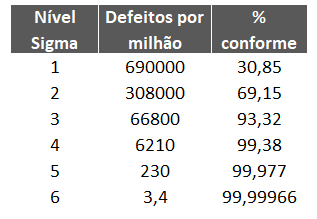
Six Sigma offers a number of advantages to companies that apply its methodology in order to improve processes and the quality of products and services. Below we list the main advantages.
The method takes into account customer demands and the quality of the final product. The expected natural result of implementation is an increase in quality, a reduction in complaints, and a reduction in identified defects.
Processes are transformed, eliminating waste to become leaner and more efficient. In this way, organizational costs are reduced over time.
It's a consequence of increased quality. High-quality products retain more customers and also attract new ones, as buzz marketing (better known as "word of mouth") gains strength among more satisfied consumers.
Activities that don't generate value for the customer or the company, such as unnecessary bureaucracy and excess information, are removed from the process to make it more fluid and easier to execute.
Six Sigma brings about a paradigm shift for the company by changing the focus to the customer and product quality. In this way, there is an internal cultural transformation that leverages results.
Reducing process variation contributes to the final quality of the product, ensuring that deadlines are met and performance is not reduced.
A widely used methodology for applying Six Sigma is DMAIC, which is inspired by PDCA (Plan-Do-Check-Act). DMAIC is used in projects where business processes already exist that need improvement. DMAIC (Define, Measure, Analyze, Improve, Control), also known as "Design for Six Sigma," is a methodology with 5 steps. Check it out!
The problem is defined through feedback provided by consumers and the objectives of processes and projects.
Some important activities and process performance are measured and important data is collected for analysis.
Measurement data is analyzed to investigate waste points, potential performance improvements, and the root cause of identified problems, as well as the impact these problems have on the process. It's important to analyze whether there's a correlation between the collected data and how they interact with each other.
This stage aims to implement improvements and take action to resolve the problems and waste points identified in the analysis stage. Several techniques can be used to achieve this. One such technique, for example, is applying "Poka-yoke" (meaning "error-proofing") to eliminate error-prone points in the work process and create a process where errors are impossible. Pilot projects are then implemented to test the capabilities of the improved process.
After implementing process improvements, the process should be constantly monitored and controlled to verify if the improvements have had an effect and actually brought the expected benefit. This also helps ensure that the processes continue to be used by everyone. Control can be done through indicators, graphs, statistics, and team meetings. The steps of Six Sigma are easy to understand; however, to implement them efficiently, it is important to have people with experience in applying Six Sigma and to structure an improvement project. It is recommended to look for a company qualified in this area, as it has certified professionals with multiple implementation experiences. Do you now have a better understanding of what Six Sigma is? Then don't hesitate to contact us to learn more about how to implement it in your company.


Statistical process control is the set of techniques that measures how a process behaves over time, separating fluctuations...

CMMI AIM (Artificial Intelligence Maturity) is the framework for...



Be the first to comment!