MPS.BR Maturity Levels: A Complete Guide to the 7 Levels

Written by: Mariano Montoni

When: April 10, 2025

MPS.BR Maturity Levels: A Complete Guide to the 7 Levels

The Brazilian Software Process Improvement Program (MPS.BR), coordinated by SOFTEX, is a national initiative created in December 2003 with the support of the Ministry of Science, Technology, Innovation and Communications (MCTIC), to increase the competitiveness of Brazilian companies, especially micro, small and medium-sized enterprises. The MPS.BR maturity levels are structured in seven progressive stages, from G to A, which guide the company towards excellence in software development.

With a focus on continuous improvement, the model is divided into three main aspects:

  • MR-MPS-SW: Software
  • MR-MPS-SV: Services
  • MR-MPS-RH: People Management

MPS assessments are conducted in companies across the country by institutions accredited by SOFTEX, and the model helps improve internal processes, productivity, performance, and technological innovation.

This guide explores in detail each of the MPS.BR maturity levels, their specific processes, and the results your company can expect when implementing the model. Understanding these levels is essential for planning your certification journey.

Technical basis for MPS.BR maturity levels

MR-MPS-SW was created based on international standards and models that serve as a reference for defining, evaluating, and improving software processes.

NBR ISO/IEC 12.207: This is the international standard that defines the entire software lifecycle, from planning to discontinuation. It describes the processes, activities, tasks, and expected results at each stage of development. MPS.BR uses this structure and terminology as a basis for defining its own processes.

The ISO/IEC 33000 family of standards offers a model for measuring and evaluating process maturity and capability, determining how to characterize and measure process execution and performance at different levels. MPS.BR uses these guidelines to establish its 7 maturity levels and evaluation criteria. The MPS.BR maturity levels follow this same structuring logic.

CMMI-DEV® (Capability Maturity Model Integration – Development): This is a globally recognized model that brings together best practices for product and service development. MPS BR for Software is compatible with CMMI-DEV V3.0, allowing companies to easily integrate or migrate practices between them.

In summary, MPS.BR brings together:

  • The ISO 12207 framework for defining processes.
  • The ISO 33000 assessment method for measuring capability and maturity.
  • Compatibility with CMMI to ensure good practices and international recognition.

The result of this combination is a flexible, progressive model that adheres to global best practices, but is adapted to the reality of Brazilian companies of different sizes. This makes the maturity levels of MPS BR accessible to organizations of all sizes.

For more details about MR-MPS-SW, consult the Guia Geral MPS de Software. Download the official guide in PDF format.

What are the MPS.BR maturity levels for Software?

MR-MPS-SW is the reference model based on MPS.BR maturity levels, which combine Processes and Capability. Each level represents a progression in this combination, making the organization more mature and predictable in its software processes.

The Process is characterized by its purpose and its expected results. The expected result of the process is met through activities and tasks. Each level of the model is met by a set of processes to be implemented.

Process Capability represents the degree of refinement and institutionalization with which the process is executed in the organization/organizational unit. Each level of the model is served by a set of associated process capabilities.

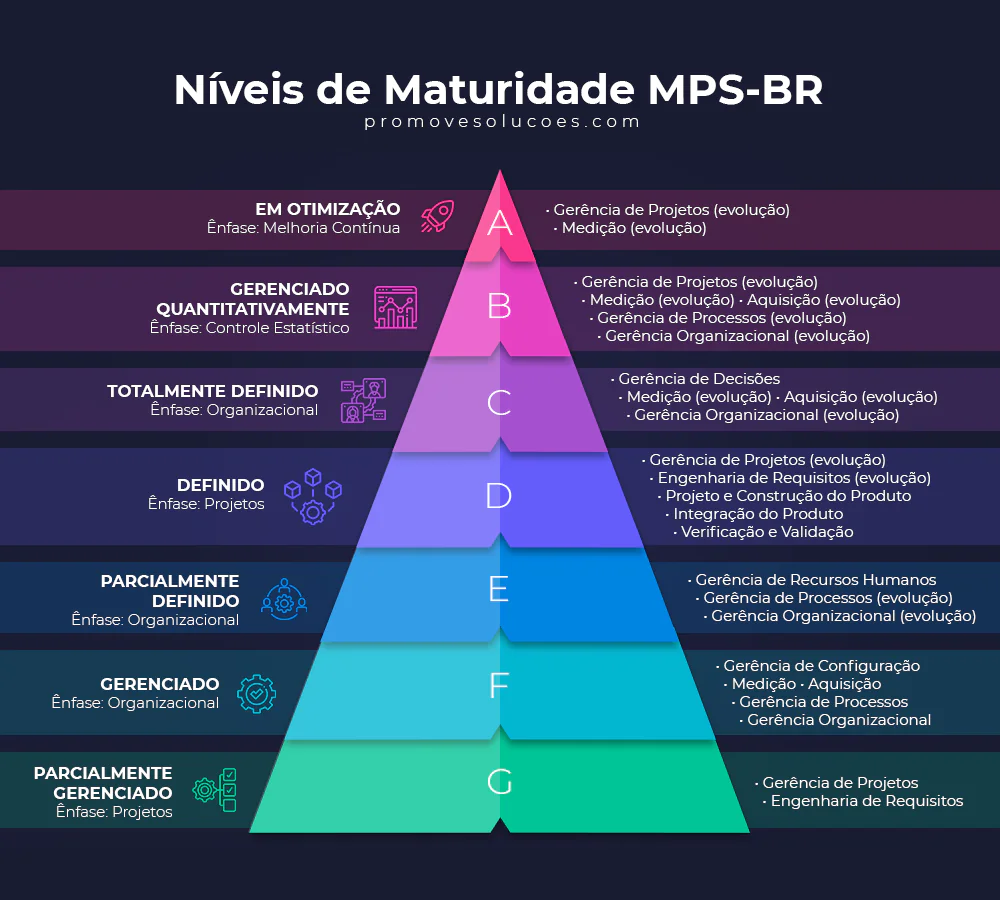
There are seven MPS.BR maturity levels, listed below from lowest to highest:

  • G – Partially Managed
  • F – Managed
  • E – Partially Defined
  • D – Largely Defined
  • C – Defined
  • B – Quantitatively Managed
  • A – Optimizing

Each of the above levels is composed of a set of Project Processes and Organizational Processes, as well as a set of Process Capability. The MR-MPS-SW Processes and Process Capability are shown in the figure below.
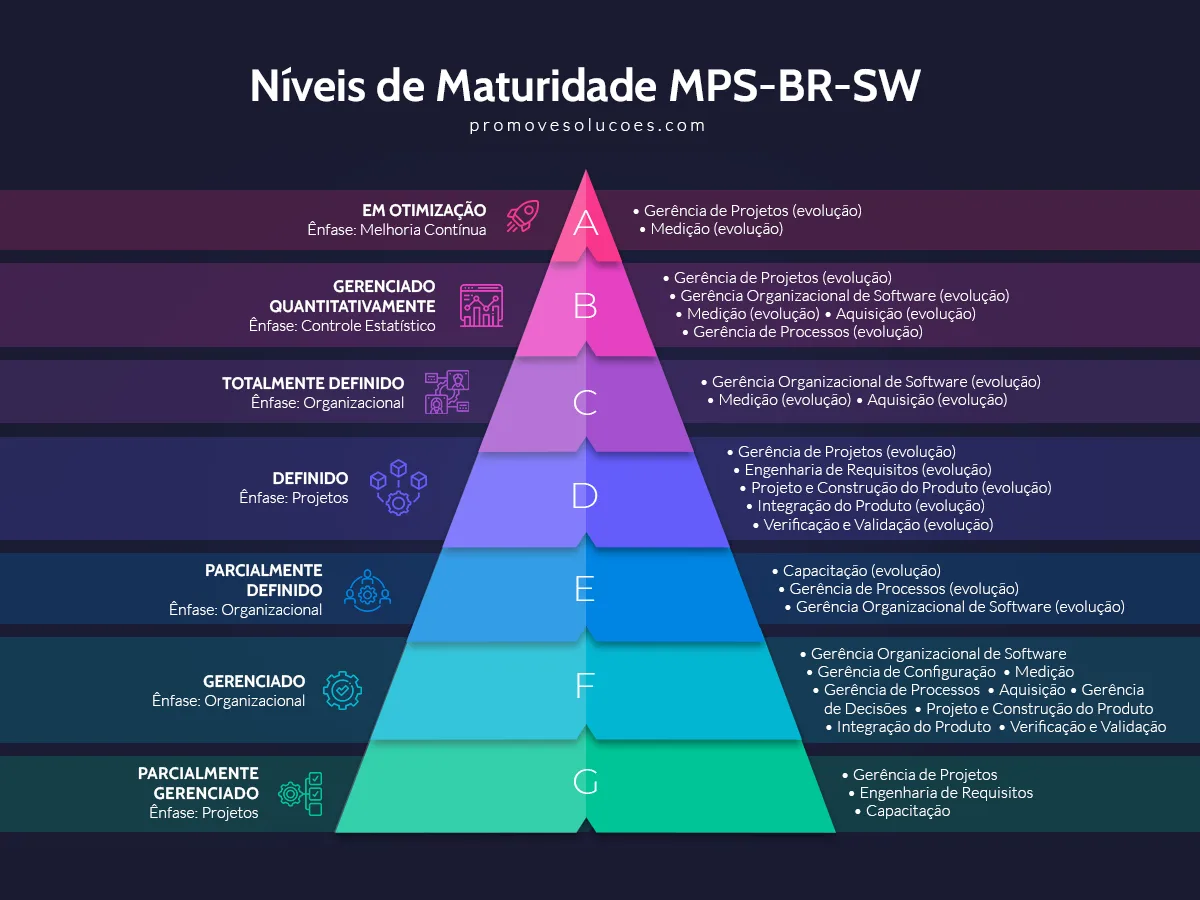
Infographic illustrating MPS-BR maturity levels in project management, from partial to optimization, highlighting processes, controls and continuous improvements.

Below are presented, for each level, the purposes of the processes, as well as the process capability as defined in the Guia Geral MPS de Software. Check it out! See below for a detailed breakdown of all MPS BR maturity levels.
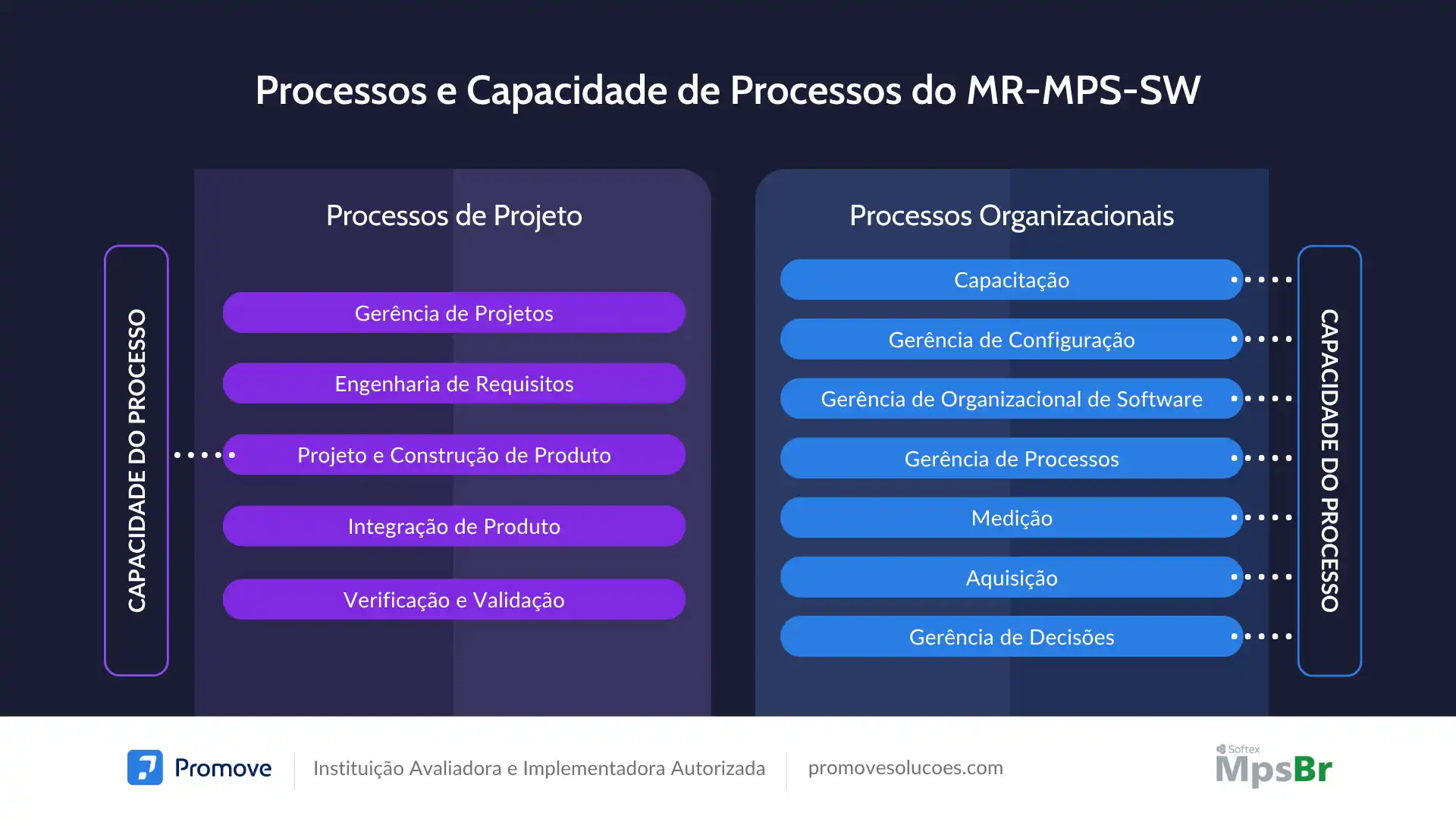
MPS-BR Process Capability Table for Software

Level G: the first of the MPS.BR maturity levels

The first level to be implemented in the model is maturity level G. It is composed of the following processes:

  • Project Management
  • Requirements Engineering
  • Training

At this level, the implementation must meet the following process capability:

  • Process Capability Level G (CP-G) – Process execution is managed: A CP-G capability process must produce the defined results, and the execution of the process must be planned and monitored. Furthermore, the people involved must be prepared to perform their responsibilities within the process.

Level F: Managed

Maturity level F is the second level of the model.

This level is composed of the processes from the previous level and nine more processes:

  • Project Management
  • Requirements Engineering
  • Product Design and Construction
  • Product Integration
  • Verification and Validation
  • Configuration Management
  • Training
  • Software Organizational Management
  • Process Management
  • Measurement
  • Acquisition
  • Decision Management

At this level, the implementation of processes must meet the capability of the previous levels and the following process capability:

  • Process Capability Level F (CP-F) – Process execution and work products are managed: A process with CP-F capability must have CP-G capability and must also perform objective verification that the process is followed, as well as ensure that work products are also objectively evaluated against the process and standards, recording the results of these evaluations and communicating and resolving nonconformities.

Level E: Partially Defined

Maturity level E is composed of the processes of the previous levels and the evolved results of the processes Training, Process Management and Software Organizational Management:

  • Project Management
  • Requirements Engineering
  • Product Design and Construction
  • Product Integration
  • Verification and Validation
  • Configuration Management
  • Training (evolution)
  • Software Organizational Management (evolution)
  • Process Management (evolution)
  • Measurement
  • Acquisition
  • Decision Management

At this level, the implementation of processes must meet the capability of the previous levels and the following process capability:

  • Process Capability Levels E/D/C (CP-E/D/C) – The process is defined: A process with CP-E/D/C capability must also have CP-F capability and must identify opportunities for process improvement during quality assurance activities, as well as provide the organization with information related to the process or process assets.

Level D: Largely Defined

Maturity level D is composed of the processes of the previous levels and the evolved results of the Project Management, Requirements Engineering, Product Design and Construction, Product Integration and Verification and Validation processes:

  • Project Management (evolution)
  • Requirements Engineering (evolution)
  • Product Design and Construction (evolution)
  • Product Integration (evolution)
  • Verification and Validation (evolution)
  • Configuration Management
  • Training
  • Software Organizational Management
  • Process Management
  • Measurement
  • Acquisition
  • Decision Management

At this level, the implementation of processes must meet the process capabilities of the previous levels.

Level C: Defined

Maturity level C is composed of the processes of the previous maturity levels and the evolved results of the Measurement, Acquisition and Organizational Software Management processes:

  • Project Management
  • Requirements Engineering
  • Product Design and Construction
  • Product Integration
  • Verification and Validation
  • Configuration Management
  • Training
  • Software Organizational Management (evolution)
  • Process Management
  • Measurement (evolution)
  • Acquisition (evolution)
  • Decision Management

At this level, the implementation of processes must meet the process capabilities of the previous levels.

Level B: Quantitatively Managed

Maturity level B is composed of the processes of the previous maturity levels and the evolved results of the Project Management, Software Organizational Management, Process Management, Measurement and Acquisition processes:

  • Project Management (evolution)
  • Requirements Engineering
  • Product Design and Construction
  • Product Integration
  • Verification and Validation
  • Configuration Management
  • Training
  • Software Organizational Management (evolution)
  • Process Management (evolution)
  • Measurement (evolution)
  • Acquisition (evolution)
  • Decision Management

At this level, the implementation of processes must meet the capability of the previous levels and the following process capability:

  • Process Capability Level B (CP-B) – The process is predictable: A CP-B capability process must have CP-E/D/C capability and must also use statistical and other quantitative techniques to determine or predict the achievement of process quality and performance objectives.

Level A: the highest level of MPS.BR maturity

Maturity level A is composed of the processes from the previous maturity levels and the evolved results of the Project Management and Measurement processes: Level A is the highest maturity level of MPS BR.

  • Project Management (evolution)
  • Requirements Engineering
  • Product Design and Construction
  • Product Integration
  • Verification and Validation
  • Configuration Management
  • Training
  • Software Organizational Management
  • Process Management
  • Measurement (evolution)
  • Acquisition
  • Decision Management

At this level, the implementation of processes must meet the capability of the previous levels and the following process capability:

  • Process Capability Level A (CP-A) – The process is continuously improved: A CP-A capability process must also have CP-B capability and must select and implement improvement proposals using results from conducting statistical and quantitative analyses on the expected effects of the improvement proposals for achieving business objectives, quality, and process performance.

The MR-MPS-SW Reference Model has been implemented since 2003, with numerous success stories.

This model is compatible with CMMI-DEV (Capability Maturity Model Integration) and prepares the organization for internationalization. Its cost-benefit is excellent for companies that want to become competitive in the domestic and foreign markets.

However, they also face many failures in implementing MR-MPS-SW. Generally, these failures are related to a "by the book" implementation that, instead of adding value, generates unnecessary bureaucracy, hindering the process.

A good implementation roadmap starts with level G, which structures the company and already implements project and requirements management concepts. Companies begin the systemic thinking of transforming requirements into processes and activities, preparing the base of the organizational maturity pyramid.

Concrete results upon reaching MPS.BR maturity levels

Using MPS-SW in your business will bring agility and more consistent results in the development of your company.

Instead of depending on the lack of definition and uncertainty in the various processes that are part of the development of your business, you will have a safe model to be adopted and followed that can certainly improve your business.

By adopting this methodology and obtaining certification for your company, the results to be achieved are more than encouraging. See the main certifications for IT companies. Some of the positive consequences of this implementation and evaluation that we could highlight are:

  • Considerable improvement in the organization of processes
  • Increased profit margin
  • Company credibility
  • Guarantee of final delivery with quality

Want to learn more about how to get MPS certified? Check out our e-book!

How to progress through the MPS.BR maturity levels in your company

You need to align your business with each of the required steps and gradually meet the requirements of each process. Implementation should occur gradually:

  1. Initial diagnosis to identify critical points.
  2. Planning with a clear roadmap, starting at level G.
  3. Implementation of processes with constant monitoring.
  4. Internal assessments and external audits to validate the results.

IT consulting firms can help you along this path by highlighting the elements that still need to be addressed within your company to achieve this excellence, as well as demonstrating the best way to extract the best results from this methodology.

Promove is an institution certified by SOFTEX to evaluate and implement the MPS BR for Software. Would you like to implement the model in your company? Do you have any questions? Contact us!
List of evaluation and implementation institutions authorized by MPS-BR.


Frequently asked questions about MPS.BR

What is MPS.BR?
MPS.BR (Brazilian Software Process Improvement) is a reference model coordinated by SOFTEX, created in 2003 with support from the federal government, to increase the competitiveness of Brazilian software companies. It defines good development practices structured in 7 maturity levels, from G (Partially Managed) to A (Optimizing).
Is MPS.BR a methodology?
MPS.BR is a reference model, not a methodology. It defines WHAT the company needs to implement — processes, capabilities, and expected results — but it doesn't prescribe how to do it. Each organization adapts the implementation to its reality, and may use agile methodologies, Scrum, or other approaches.
What are the maturity levels of MPS.BR?
The MPS.BR maturity levels for software are seven: G (Partially Managed), F (Managed), E (Partially Defined), D (Largely Defined), C (Defined), B (Quantitatively Managed), and A (Optimizing). Most companies start with the lowest MPS.BR maturity levels, such as G, and progress gradually.
What is the difference between MPS.BR and CMMI?
CMMI has a global focus and is more widely adopted by larger companies that need international recognition. MPS.BR was created by SOFTEX focusing on Brazilian micro, small, and medium-sized enterprises, with a more accessible assessment cost. The two models are compatible: MPS.BR is aligned with CMMI-DEV, allowing companies to integrate or migrate practices between them.
What does level C mean in MPS.BR?
Level C is called "Defined." At this level, processes are standardized throughout the organization, with advanced improvements in Measurement, Acquisition, and Organizational Software Management. The CP-E/D/C process capability requires that processes be formally defined and that opportunities for improvement be identified during quality assurance activities.
Who created MPS.BR?
MPS.BR was created by SOFTEX (Association for the Promotion of Excellence in Brazilian Software) in December 2003, with support from the Ministry of Science, Technology, Innovation and Communications (MCTIC). It is based on international standards such as ISO/IEC 12207 and ISO/IEC 33000, and is compatible with CMMI-DEV V3.0.

Mariano Montoni

He is one of only two Brazilians certified as a CMMI High Maturity Lead Appraiser. He has over 20 years of experience driving excellence in the processes of technology companies, having conducted more than 150 official appraisals in the CMMI and MPS.BR models. With a Black Belt certification in Lean Six Sigma, he is also able to apply advanced process improvement techniques.

Comments

Your email address will not be published. Required fields are marked with *.

Be the first to comment!


Similar Articles

High maturity of CMMI: how statistical process control brings real predictability to software projects
Governance and Processes
October 28, 2026

High maturity of CMMI: how statistical process control brings real predictability to software projects

Statistical process control is the set of techniques that measures how a process behaves over time, separating fluctuations...
Read article
CMMI AIM: the framework for maturity in artificial intelligence.
Artificial Intelligence
July 16, 2026

CMMI AIM: the framework for maturity in artificial intelligence.

CMMI AIM (Artificial Intelligence Maturity) is the framework for...

Read article
The iFood data breach exposed the data of over one million users. The vulnerability that allowed this is more common than it seems.
Information Security
June 19, 2026

The iFood data breach exposed the data of over one million users. The vulnerability that allowed this is more common than it seems.

The iFood data breach took months to become public. The incident occurred in December 2025. Confirmation only came in June 2026, after...
Read article