Technology Readiness Levels (TRL): How to measure technological maturity using the scale used by NASA.

Written by: Promove Soluções

When: October 9, 2025

Technology Readiness Levels (TRL): How to measure technological maturity using the scale used by NASA.

The Technology Readiness Level (TRL), created by NASA in the 1970s, is a scale used worldwide by agencies and institutions to classify technologies at different stages of technological maturity.

It is based on evidence from testing, analysis, and validation that demonstrates where a technology is in its lifecycle from research to implementation.

Besides NASA, one of the main entities that adapted and disseminated the TRL was the Federal Highway Administration (FHWA), an agency within the United States Department of Transportation responsible for policy, research, and innovation in highway infrastructure. Since then, the model has established itself as an international benchmark, used in sectors such as transportation, defense, energy, healthcare, and aerospace.
The 9-level Technology Readiness Level Scale

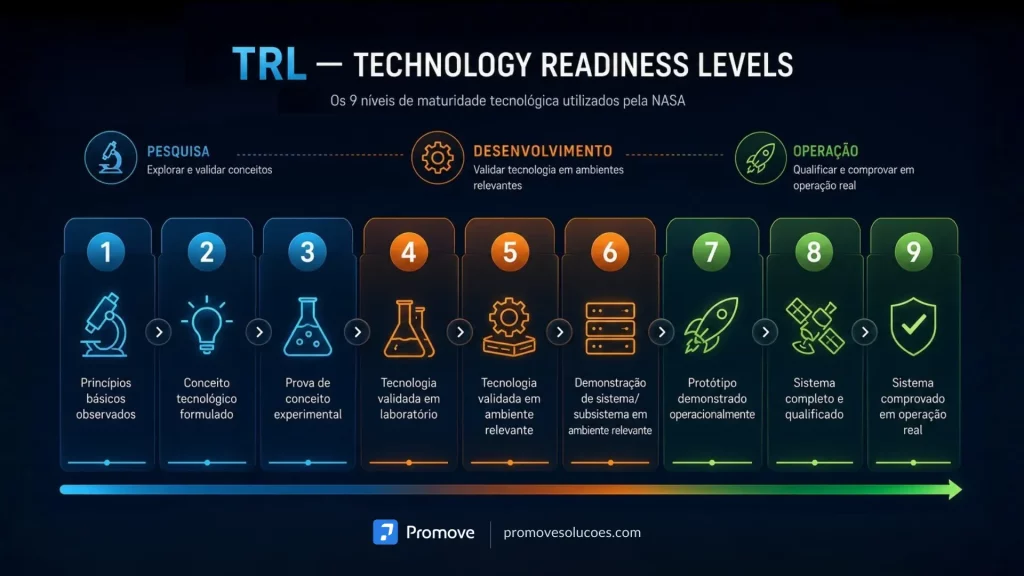
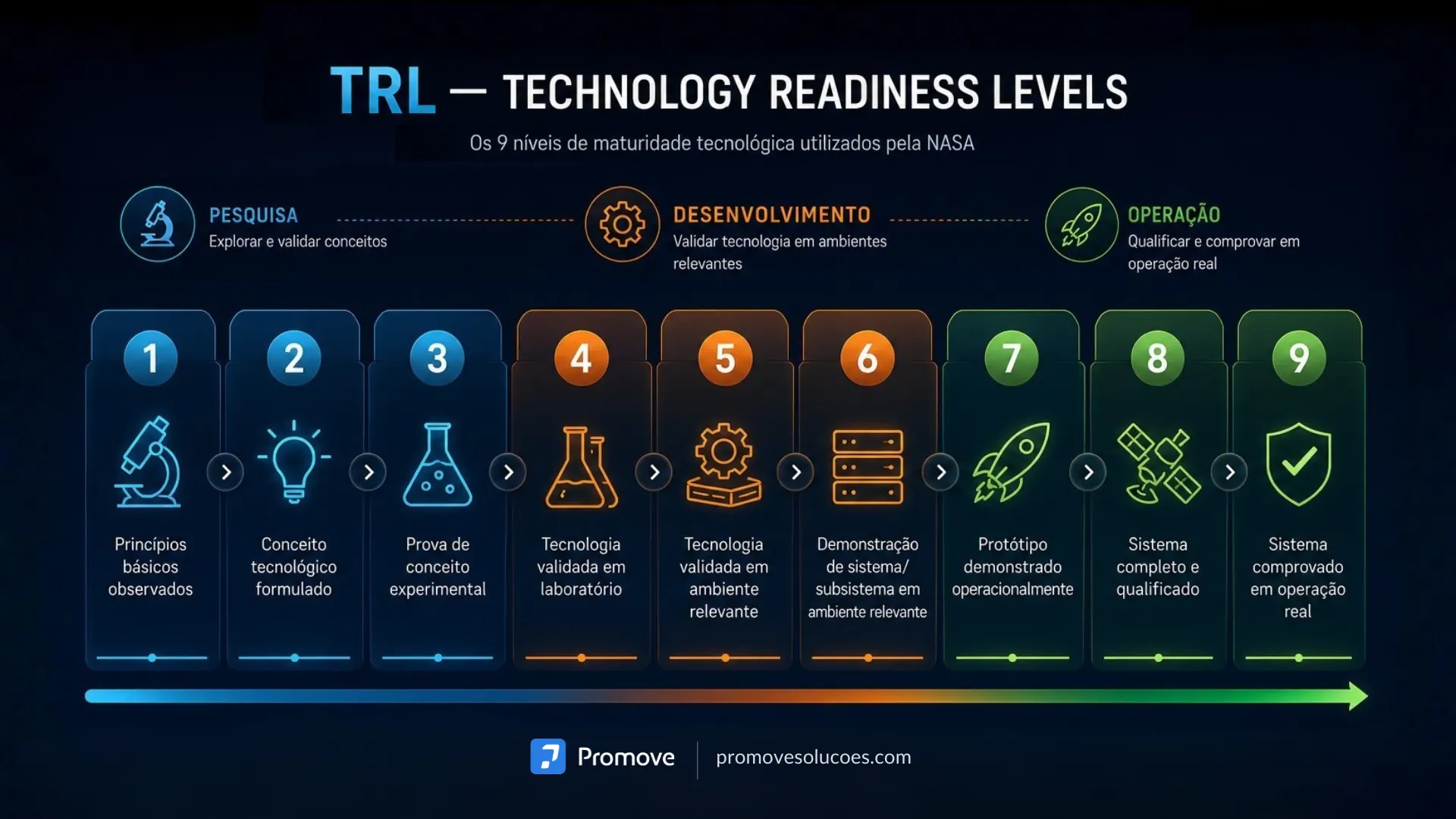
Technology Readiness Level (TRL): infographic on technology readiness levels with NASA's research, development, and operation stages, from level 1 to 9.

According to NASA and FHWA, the Technology Readiness Levels are organized as follows:

  • TRL 1: The basic principles are observed and reported, that is, initial research, still without defined application;
  • TRL 2: The formulation of the concept or technological application occurs;
  • TRL 3: Analytical and experimental proof of concept, the first feasibility tests are carried out;
  • TRL 4: Validation of components in a laboratory environment;
  • TRL 5: Validation of integrated components in a relevant environment (not necessarily in the field, but under realistic conditions);
  • TRL 6: Prototype close to the final model demonstrated in a relevant environment;
  • TRL 7: Prototype demonstrated in operational environment;
  • TRL 8: Complete system tested and qualified in a real environment;
  • TRL 9: System in proven operation, fully implemented.

Progression is sequential, meaning that for a technology to advance, it must meet all the requirements of the current and previous levels.

Why use the Technology Readiness Level (TRL)?

According to the FHWA (Federal Highway Administration) guide, TRL helps to:

  • Standardize technical communication; when we say "TRL 6," the evaluator, proposer, and partners know exactly what that level represents.
  • Map risks by clearly seeing which steps are still missing and plan for mitigation;
  • Improve efficiency in resource allocation: projects with TRL prevent money from going to ideas that are still too immature;
  • Attract partners and investors who are looking for projects with technical evidence.

The Technology Readiness Level assessment process

The TRL Assessment is the formal methodology for assigning a level to a technology, and according to the FHWA guide, this process involves:

  • Preparation: Defining objectives, selecting a panel of experts, and organizing reference materials.
  • Assessment: Discussion and collective scoring by experts, based on evidence from tests and validations.
  • Results: Preparation of a report that consolidates the assessment, recommendations, and next steps for technological advancement.

Limitations of the Technology Readiness Level (TRL) and the human dimension.

Although TRL is widely accepted, researchers emphasize that its application is technology-centric, that is, it focuses only on technical development. 

  • Does not measure human factors such as ease of use or workload.
  • It does not assess costs, market risks or economic sustainability.
  • It depends on the evaluators' interpretation, which can generate variation in the results.

The article "Technology Readiness Level as the Foundation of Human Readiness Level" (access it here) points out that the TRL does not consider the readiness of the technology to be used by humans.

Failures in sectors such as nuclear, aviation, and cybersecurity show that most accidents stem from human factors. To address this gap, the concept of Human Readiness Level (HRL) was created, inspired by the TRL framework but focused on measuring usability, safety, and user satisfaction.

Just as the TRL has nine levels, the HRL is also structured in stages that evaluate everything from the initial understanding of the human use scenario to the validation of the technology in operation with real users.

Practical example: FAPEMIG and the Deep Tech MG call for proposals

FAPEMIG (Fundação de Amparo à Pesquisa do Estado de Minas Gerais) is an excellent example in Brazil of the use of TRL in innovation calls for proposals. In its calls, such as Deep Tech MG (2025), FAPEMIG requires startups to submit technologies with a TRL of 6 or higher to be eligible or to have priority.

Why is that? It means the technology has already been tested in a relevant environment, not just in a laboratory, but in conditions close to the reality the user will face. This reduces risks for the foundation and the entrepreneur.

In the context of this call:

  • If you are still on TRL 4 or 5, you will need to advance to TRL 6 before submitting;
  • You will need to provide evidence: test reports, photos/videos of the prototype in operation, performance data, metrics, technical reports, integration with real context;
  • You are also expected to have a clear roadmap for progressing from TRL 6 → 7 → 8 → 9, outlining milestones and deadlines.

Thus, FAPEMIG filters projects that have already demonstrated technical capacity beyond the laboratory and focuses on initiatives with a real chance of scale, market and social impact.

Conclusion

The Technology Readiness Level (TRL) is currently one of the tools used to assess technological maturity in sectors such as transportation, defense, energy, healthcare, and aerospace. It provides a common language for comparing projects, understanding development risks, and guiding investments.

However, as recent studies demonstrate, its isolated application does not guarantee success in real-world use. The evolution towards complementary concepts, such as the Human Readiness Level (HRL), reinforces the need to consider the human factor at all stages of research and innovation, especially in projects seeking scale and real impact.

Promove Soluções

Promove is recognized for having leading consultants in Brazil and worldwide. We offer specialized consulting services for software companies, focusing on implementing an agile culture, compliance with ISO and LGPD standards, and CMMI and MPS quality models.

Comments

Your email address will not be published. Required fields are marked with *.

Be the first to comment!


Similar Articles

High maturity of CMMI: how statistical process control brings real predictability to software projects
Governance and Processes
October 28, 2026

High maturity of CMMI: how statistical process control brings real predictability to software projects

Statistical process control is the set of techniques that measures how a process behaves over time, separating fluctuations...
Read article
CMMI AIM: the framework for maturity in artificial intelligence.
Artificial Intelligence
July 16, 2026

CMMI AIM: the framework for maturity in artificial intelligence.

CMMI AIM (Artificial Intelligence Maturity) is the framework for...

Read article
The iFood data breach exposed the data of over one million users. The vulnerability that allowed this is more common than it seems.
Information Security
June 19, 2026

The iFood data breach exposed the data of over one million users. The vulnerability that allowed this is more common than it seems.

The iFood data breach took months to become public. The incident occurred in December 2025. Confirmation only came in June 2026, after...
Read article