
Kanban vs. Scrum: Understand the differences and similarities

Written by: Promove Soluções

When: September 6, 2024

Kanban vs. Scrum: Understand the differences and similarities

In the world of agile methodologies, Kanban and Scrum are two widely adopted approaches for managing and improving processes in software projects and other areas. Both aim to increase efficiency and productivity, but each has unique characteristics that can influence the choice of the most appropriate methodology for a specific team or project. In this article, we will explore in detail the applicability, differences, and similarities between Kanban and Scrum, helping you better understand which methodology may be best for your needs.

What is Kanban?

Kanban is a workflow management methodology that originated in the manufacturing industry and has been adapted to a variety of other contexts, such as software development. The term “Kanban” means “visual card” in Japanese, and the approach is based on visualizing work on a board (the Kanban Board), which helps control the flow of tasks and identify bottlenecks in the process. Kanban became quite popular as an integral part of TQM (Total Quality Management), developed by several business consultancies in the United States in the 1960s. The Japanese company Toyota was the first company to implement TQM, having won the Deming Prize for quality management in 1985.

Main components

  • Kanban Board: A visual board where tasks are represented by cards and organized into columns that reflect different stages of the workflow (e.g., “To Do,” “In Progress,” “Done”). These stages should reflect the organization’s current production process and may gain complexity from improvements made in the value creation chain.
  • Work in Progress (WIP) Limits: Limits are imposed on the maximum number of tasks that can be in each column at the same time. This helps prevent overload and improve focus and efficiency.
  • Continuous flow: Kanban does not use sprints or fixed cycles; work flows continuously through the different stages of the process. However, it does provide for moments of rebalancing the value chain.
  • Review Meetings: Kanban can have regular meetings to review the workflow and identify areas for improvement, but there is no fixed format for these meetings.

What is Scrum?

Scrum is a structured agile methodology that focuses on incremental and iterative delivery. Initially developed for software development, Scrum has proven effective across a wide range of projects. It is based on cycles of work called “sprints” and is structured around specific roles, events, and artifacts.

Main components

  • Sprints: Fixed periods (usually 2-4 weeks) during which a team works to deliver a part of the product or a specific functionality.
  • Scrum Roles: They include the Scrum Master (facilitator), the Product Owner (responsible for the product backlog) and the development team.

  • Scrum Events: They include Sprint Planning, Daily Stand-up, Sprint Review, and Sprint Retrospective.
  • Scrum Artifacts: They include the Product Backlog (list of all product requirements) and the Sprint Backlog (list of tasks to be accomplished during the sprint).

Similarities between Kanban and Scrum

Despite their differences, Kanban and Scrum share several characteristics:

  • Focus on Continuous Improvement: Both methods emphasize continuous improvement and adaptation to increase team efficiency and effectiveness.
  • Transparency and Visualization: Kanban and Scrum both promote transparency through visualization of work. In Kanban, this is done through the Kanban board, while in Scrum, visualization occurs through the Scrum Board and other artifacts.
  • Regular Feedback: Both methods incorporate regular feedback to drive improvement. In Kanban, this can occur in workflow review meetings, while in Scrum it is done through sprint review and retrospective meetings.
  • Focus on Value: Both Kanban and Scrum aim to deliver continuous value to the customer, either through incremental improvements (Scrum) or through efficient workflow management (Kanban).

Differences between Kanban and Scrum

While Kanban and Scrum share some similarities, their differences can significantly influence the choice of methodology for different teams and projects.

1. Structure and Flexibility

  • Kanban: It offers a more flexible and less structured approach. It does not require changes to existing work practices and can be easily adjusted to different types of projects and teams. As we often explain, Kanban is an EVOLUTION and not a REVOLUTION. Start with the process you have today (As Is) and mature it by improving it over time.
  • Scrum: It has a more rigid structure with defined roles, events, and artifacts. This can provide clear direction and a regular cadence, but may be less flexible to abrupt changes. Scrum can be understood as a REVOLUTION because it significantly changes the way an organization works to fit the Scrum values ​​and culture.

2. Work Cycles

  • Kanban: Adopts a continuous flow of work without sprints or fixed cycles. Work is managed continuously, allowing for more fluid adaptation to changes and priorities.
  • Scrum: Works in sprints, which are fixed periods of time for completing tasks. This allows for regular review and adaptation, but can be more rigid in adapting to changing priorities between sprints.

3. Roles and Responsibilities

  • Kanban: It does not define specific roles within the team, allowing for a more fluid and collaborative approach.
  • Scrum: Defines clear roles, such as Scrum Master, Product Owner and development team, each with specific responsibilities.

4. Planning and Prioritization

  • Kanban: Planning is less formal and can occur as needed. Priorities are adjusted according to workflow and team capacity.
  • Scrum: Planning is more formal and structured. Priorities are defined in the Product Backlog and are refined during sprint planning meetings.

5. Adaptability and Change

  • Kanban: It is more adaptable to frequent changes, allowing new tasks to be added and adjusted into the ongoing workflow.
  • Scrum: Changes are managed between sprints, which can make the process less flexible for immediate adjustments.

When to use Kanban or Scrum?

The choice between Kanban and Scrum should depend on the specific needs of your team and project. Here are some considerations to help you decide:

  • Kanban: Ideal for teams that need flexibility and continuous workflow management. It is suitable for projects with variable tasks and for environments where frequent changes are common.
  • Scrum: Suitable for teams that can benefit from a more rigid structure and defined work cycles. It is useful for projects that can be broken down into smaller increments and where there is a need for a regular planning and review cycle.

Conclusion

Both Kanban and Scrum offer effective approaches to project and process management, each with its own strengths and suitability. Choosing between them should consider the nature of the work, the team's needs, and the project's dynamics.

By understanding the similarities and differences between these methodologies, you can make an informed decision and implement the approach that best meets your specific needs, promoting greater efficiency and success in your projects.
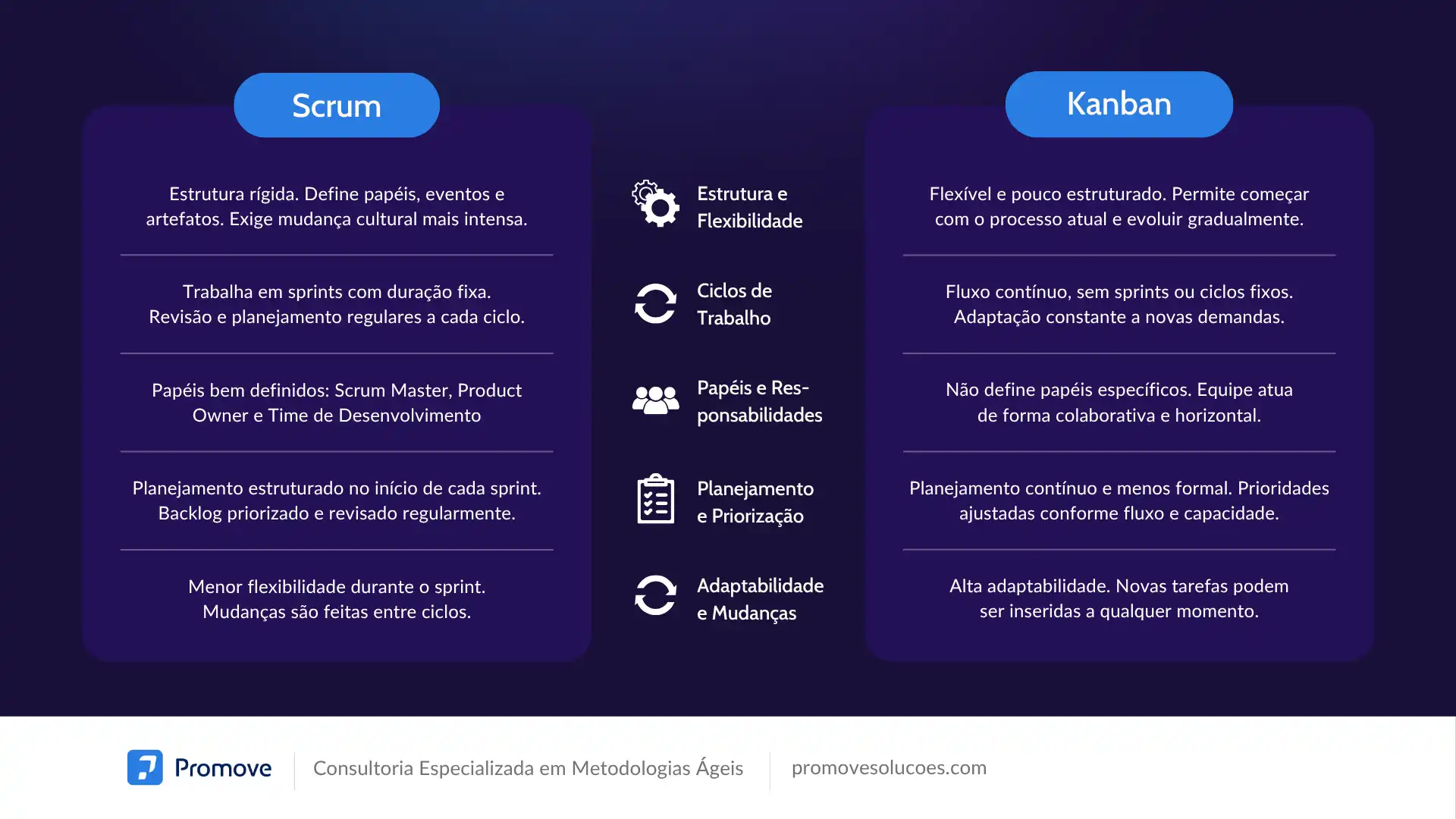
Comparative image between Scrum and Kanban, highlighting the structure, flexibility, work cycles, roles, planning, and adaptability of each agile method.

Reliable sources

To ensure that you find the most accurate and complete information, we recommend consulting specific sources. Below are some reliable sources that can be used to deepen your knowledge about Kanban and Scrum and for additional reference:

1. Kanban: Successful Evolutionary Change for Your Technology Business, by David J. Anderson: This book is a fundamental reference for understanding the practical application of Kanban in technology and business environments.

2. Scrum: The Art of Doing Twice the Work in Half the Time, by Jeff Sutherland: Written by one of the co-creators of Scrum, this book offers a detailed and accessible overview of how Scrum can improve efficiency and productivity.

3. Scrum.org: The official Scrum.org website offers a wide range of resources, including guides, articles, and courses on Scrum.

4. Kanban University: Kanban University provides detailed information and resources on the implementation and principles of Kanban.

5. Kanban from the Inside, by Mike Burrows: This book offers an in-depth look at the principles and practices of Kanban, ideal for those who want a more detailed understanding of the methodology.

6. Essential Kanban Condensed, by David J. Anderson and Andy Carmichael: This is a compact guide that summarizes the essential principles and practices of Kanban, useful for those who need a quick overview.

7. Atlassian's Agile Guide: Atlassian provides a detailed guide to Scrum and Kanban, including comparisons and practical tips.

8. PMI – Project Management Institute: The PMI offers resources on project management, including agile practices and comparisons between different methodologies.

These sources provide detailed and comprehensive information about Kanban and Scrum, helping you deepen your understanding and apply the concepts effectively across projects and teams.

On our blog, you'll find a section dedicated to Agile methodologies, with clear content and practical examples to help you decide which path to follow in managing your projects.

Ready to improve your processes with Agile Methods?

Our team is highly specialized and experienced in implementing Agile Methodologies, ensuring effective and continuous application to improve team productivity and the quality of software deliverables. Learn about our services. And, if you need anything, get in touch!


Promove Soluções

Promove is recognized for having leading consultants in Brazil and worldwide. We offer specialized consulting services for software companies, focusing on implementing an agile culture, compliance with ISO and LGPD standards, and CMMI and MPS quality models.

Comments

Your email address will not be published. Required fields are marked with *.

Be the first to comment!


Similar Articles

High maturity of CMMI: how statistical process control brings real predictability to software projects
Governance and Processes
October 28, 2026

High maturity of CMMI: how statistical process control brings real predictability to software projects

Statistical process control is the set of techniques that measures how a process behaves over time, separating fluctuations...
Read article
CMMI AIM: the framework for maturity in artificial intelligence.
Artificial Intelligence
July 16, 2026

CMMI AIM: the framework for maturity in artificial intelligence.

CMMI AIM (Artificial Intelligence Maturity) is the framework for...

Read article
The iFood data breach exposed the data of over one million users. The vulnerability that allowed this is more common than it seems.
Information Security
June 19, 2026

The iFood data breach exposed the data of over one million users. The vulnerability that allowed this is more common than it seems.

The iFood data breach took months to become public. The incident occurred in December 2025. Confirmation only came in June 2026, after...
Read article