
Organizational maturity in process development has grown, and with it, the search for high competitiveness and quality has also increased.
Furthermore, companies have no time to waste on closed-scope projects that last more than 6 months.
Therefore, organizations are increasingly adopting agile approaches, with the main objective of increasing business value for the organization.
With this growing interest in agile methods, many questions arise in the market regarding these models. Here are some:
Understanding that traditional management models and agile methods share the same goal: achieving project success, how can agile practices be adapted to the organizational context? Which agile approach is best for my company?
We will begin with a timeline of agile methodologies that initially emerged in the IT (Information Technology) field and are now widely used in other domains, such as auto repair shops, hospitals, businesses, lawyers, and even for personal use.
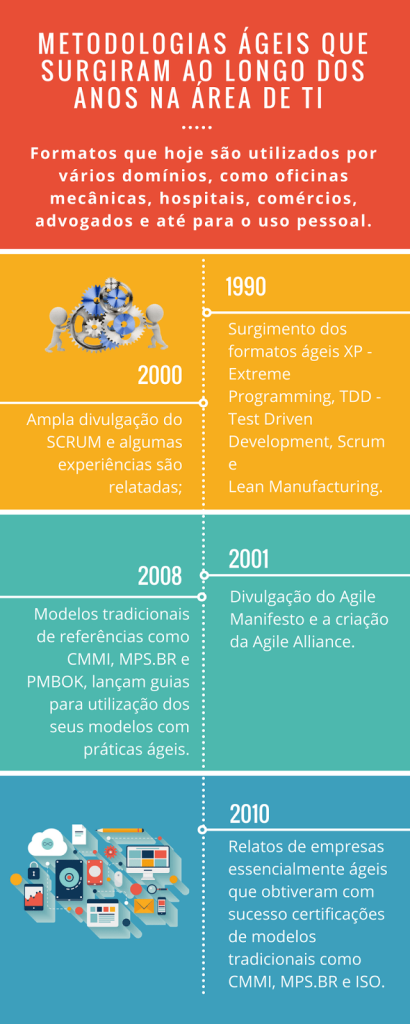
Over the years, these methodologies have emerged and, with them, myths and stories about their effectiveness have also come to light.
Many people doubted the effectiveness of agile processes and asserted the following lies, which, in fact, have been debunked and clarified over time:
Do you see how these statements make no sense? It's completely incoherent to say that not adopting agile management means adopting a process without documentation.
If there are documents that need to be generated, they should be included as tasks and reviewed in the “done” criteria.
The values and principles of agility are all about adding value to the customer. If such documents are important to the customer, they will be generated.
Agile environments, by promoting common sense and team spirit, tend to be much quieter and more disciplined than traditional teams.
Some teams have clear rules regarding cell phone use and side conversations posted on the board.
Agile teams are typically more mature and, therefore, understand the importance that must be given to ceremonies, indicators, and project monitoring.
Geographically distributed and/or large teams are a challenge for any type of approach, whether traditional or agile.
To help with this, there are facilitation or coaching techniques that are being widely used in projects that facilitate team building and shorten distances.
You can see doctors, lawyers and even insurance companies in these tracks.
When talking about agile methodologies, one cannot fail to mention the agile manifestos – their principles and values.
The emergence of the agile manifesto occurred in mid-2000, when a group of influential agilists from the XP (Extreme Programming) community decided to discuss new techniques to eliminate some process flaws.
Learn the full story of the Agile Manifesto.
The Agile Manifesto is simple, direct, and clear. Learn about the four values and 12 principles of this methodology:
There are interpretations regarding this manifesto, where they translate the adverb of intensity “more than” as not having.
The Manifesto establishes a prioritization regarding common issues in projects, introducing a mindset of collaboration, simplification and action.
To elaborate on this thinking, I've listed the agile principles below. They can be summarized as (Learning, Feedback, and Iterative Development):
“Our highest priority is to satisfy the customer through early and frequent delivery of valuable software.”
The focus in product or service development is on providing value to the customer, that is, the main concern is customer satisfaction.
Changing the scope and/or previously made plans whenever necessary is a priority, since delivering something of value is more important than following an initial plan.
"Accept changing requirements, even late in development. Agile processes adapt to change, so the customer can gain competitive advantages."
Agile processes use change to provide competitive advantage to the customer.
Accepting change as something that will always exist and preparing to deal with it is essential.
When we define short feedback cycles, this evolution of team and client knowledge is allowed.
A bureaucratic change process discourages and often prevents change that is critically necessary for project success.
“Deliver working software frequently, on a scale of weeks to months, with a preference for shorter periods.”
Frequently deliver parts of the product and/or service that have value to the user and/or customer.
This makes it possible to provide quick feedback to the client, reducing various project risks (whether related to scope, deadline, or technology).
This principle opposes making few or, at the limit, a single value delivery, only at the end of the project (the traditional waterfall life cycle).
“Business people and developers must work together daily throughout the entire project.”
Working together and constant communication need to be carried out frequently, objectively and daily.
This principle opposes the lack of communication between users and the team, between the team itself, and between the team and its leaders. People don't work in shadowy, isolated ways.
"Build projects around motivated individuals. Give them the necessary environment and support, and trust them to do their job."
Valuing people and the need for daily motivation through increased visibility and the rules of the game. Trust is key to teamwork.
“The most efficient and effective method of conveying information to and within a development team is face-to-face conversation”
The best form of communication between members of the team developing the product and/or service and between that team and the outside world is face-to-face communication.
In other cases, it is possible to use team building tools and techniques to build something very close to the synergy that exists face-to-face.
“Working software is the primary measure of progress.”
Have the main objective of generating a product/or service that has some value to the customer rather than something that will not be used.
Documentation must be useful and aim to increase added value to the customer, translated into parts of products or services.
"Agile processes promote a sustainable environment. Sponsors, developers, and users must be able to maintain constant progress indefinitely."
Agile processes promote sustainable development. Therefore, a constant and sustainable pace must be defined for the work of the team developing the product and/or service, which becomes possible when this pace is supported by the entire chain, including Senior Management and Clients.
Overtime brings demotivation and a lack of quality of life, which harms productivity and, consequently, the achievement of project objectives.
“Continuous attention to technical excellence and good design increases agility.”
Quality must be a constant and unwavering concern. Quality must take precedence over deadlines and productivity.
“The art of maximizing the amount of work not done – is essential.”
When you don't do something that isn't necessary, you avoid wasting product and service development.
So, to begin, create useful documentation to be used and plan the details you know.
“The best architectures, requirements, and designs emerge from self-organizing teams.”
Teams with greater autonomy and self-organization are more efficient. This characteristic of not waiting for commands brings responsibility and freedom to decide the best way to carry out a task.
“At regular intervals, the team reflects on how to become more effective and then refines and adjusts its behavior accordingly.”
To become increasingly effective, the team regularly inspects its ways of working and adapts when opportunities for improvement are identified, promoting continuous incremental improvement.
It is an iterative and incremental process for developing any product and managing any project.
Finally, having explained what agile processes are and their entire history, we can talk about it, one of the greatest forms of process optimization, known worldwide.
Developed to manage more complex processes, SCRUM has the following characteristics:
SCRUM has the following pillars:
Scrum is based on:
Product Owner: The Product Owner's role is to ensure ROI, understand customer needs, keep backlog items updated and prioritized, accept or reject what has been produced, have high involvement at the beginning and end of the sprint, manage requirements, plan releases, and clarify doubts.
Scrum Master: This team is responsible for removing impediments to the team, ensuring the use of Scrum, protecting the team from external interference, teaching value maximization, improving the day-to-day work of team members, combating the illusion of command and control, prioritizing and removing impediments, and facilitating meetings.
The team must be multi-disciplinary, self-managed, produce quality work that adds value to the client, have a maximum of 9 committed members, be responsible for achieving the objective, be communicative, and be capable of resolving conflicts.
The Scrum Flow, illustrated in the figure below, is characterized by regular cycles of 2 or 4 weeks maximum, called Sprints.
The life cycle can be considered evolutionary (knowledge about requirements evolves as increments are executed).
The requirements to be produced in a project are kept in a list named Product Backlog.
At the beginning of each Sprint, a Sprint Planning Meeting 1 and 2 is held, that is, a planning meeting in which the Product Owner prioritizes the items that are in the Product Backlog (Sprint Planning 1) and the team defines and estimates the tasks that it will be able to implement during the Sprint that is starting.
The tasks allocated to a Sprint are then included in the Sprint Backlog.
Every day, throughout the Sprint, the team holds a short meeting (usually in the morning), called the Daily Scrum.
The purpose of this meeting is to make the progress of tasks visible, identify impediments, and prioritize the work for the coming day.
At the end of a Sprint, the team presents its achievements to the Product Owner in a ceremony called a Sprint Review Meeting. Finally, a Sprint Retrospective is held, where areas for improvement and actions for the next Sprint (continuous improvement) are discussed.
Next, the team moves on to planning the next Sprint. Thus, the cycle begins again.
In short, that's how SCRUM works. Interested? Tell us in the comments about the implementation processes of this framework and contact us if you want to know more about how to do it!


Statistical process control is the set of techniques that measures how a process behaves over time, separating fluctuations...
CMMI AIM (Artificial Intelligence Maturity) is the framework for...



Be the first to comment!