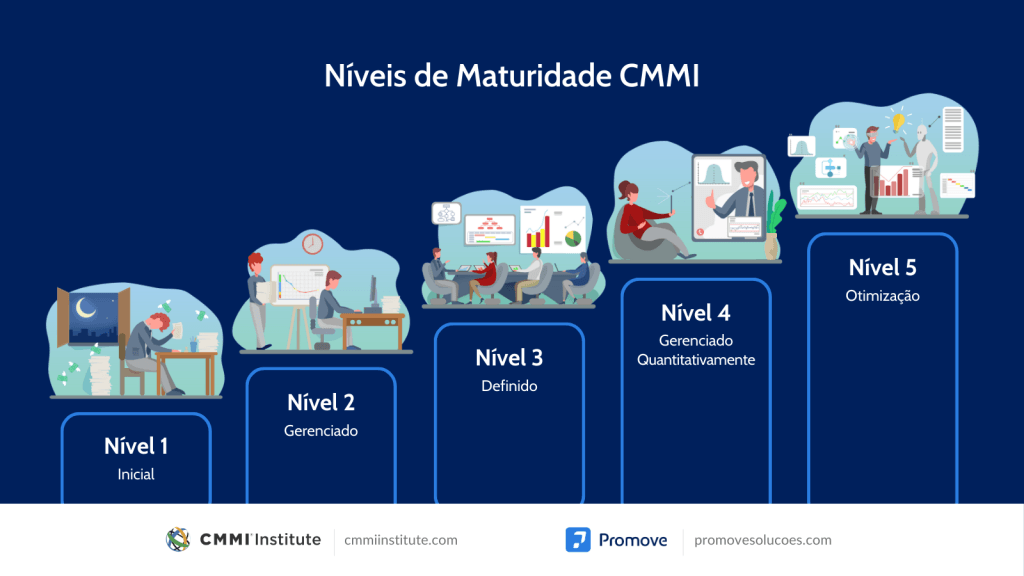
The CMMI model establishes 5 maturity levels, starting from Level 1 – Initial, then Level 2 – Managed, Level 3 – Defined, Level 4 – Quantitatively Managed, and finally Level 5 – Optimizing.
These levels contain groups of practices that establish levels of evolution for a company that produces hardware and software, as well as companies that provide services.
In this article, we describe the CMMI levels along with explanatory scenarios to help you understand how your company can benefit from CMMI.
If you're new to the world of CMMI, you might be wondering what this acronym means. The term CMMI comes from the English "Capability Maturity Model Integration".
This model was created in the 80s at the request of the United States Department of Defense to help assess the ability of its suppliers to develop systems within the expected timeframe, budget, and quality.
The CMMI model is a set of practices from various areas, such as project management, product engineering, process management, among others. Companies that implement processes that adhere to CMMI practices can show the market that they are capable of delivering quality products and services within predictable timeframes and costs.
Therefore, it is possible to state that the risk of hiring a company that has CMMI is lower than hiring companies without CMMI.
The model is constantly evolving: the current version is CMMI 3.0, published by ISACA in April 2023, focusing on simplification and greater integration with agile practices, DevOps, and information security.
CMMI can be used by companies that produce hardware and software or provide services, for example, systems support and help desk, as well as companies that contract suppliers to develop products or provide services.
For each of these types of companies, there is a CMMI model domain containing a specific set of practice groups. The CMMI model domains are as follows:
However, a company can use multiple domains of the CMMI model at the same time. For example, a software factory that provides development, support and operation services for public agencies can implement processes that adhere to both the CMMI Development and the CMMI Services practices.
After implementing processes based on CMMI best practices, an analysis of the organization's maturity is conducted considering the five levels. This is necessary because it's important to understand the company's current level of development, and also for making decisions regarding improvements and new practices.
To better understand, check out each of these levels below.
At maturity level 1, called Initial, the outcome of the work is unpredictable and reactive. At this level, although the work is completed, it is often delayed and exceeds the budget.
At this first level, the organization is at a critical point, as it lacks defined processes and is unable to implement adequate plans. It's a time when everything happens haphazardly, and errors, which are usually numerous, are corrected with simplistic practices that yield little result.
In companies that are still at this level, it is very common for there to be late deliveries, excessive spending and unclear goals for employees. Therefore, the company's lack of maturity requires great effort from managers and teams, as they have to deal with problems without knowing the correct practices.
This figure is a good example of a company at maturity level 1. In the figure, we see a person working late, with few resources and money being wasted. As incredible as it may seem, this is how many people work today, that is, in a completely amateur way. You certainly wouldn't want to hire a company that performs work under these conditions, would you?

Maturity level 2 is called Managed. At this level, work is managed at the project level. There is planning, execution, measurement, and control of projects.
Companies that are at the second level of maturity still have initial processes, but with the difference that they can more easily control the costs and deadlines of projects for delivering products and services.
At this level, managers can define clear and effective planning in order to optimize company practices and culture. In addition, organizations can now produce best practice reports and gain experience with the new management approach.
This other figure illustrates the scenario of a company at maturity level 2. Here we see a team working more collaboratively, with more resources than at level 1. However, we can see that some difficulties still exist, as we can see in the graph in the background, which shows a drop in a performance indicator followed by a slight improvement.
Furthermore, resources are not yet ideal, and companies still experience significant losses and waste, affecting not only project profit margins but also impacting customer satisfaction.

Maturity level 3 is called Defined and is considered more proactive and less reactive than previous levels. A key point of this level is the definition of process standards for the entire organization, providing guidance across projects, programs, and portfolios.
>
Companies at the third level already have well-defined processes. Their documentation is standardized and their practices are uniform; that is, everyone knows what needs to be done at each stage of product development or service delivery. At this point, employees are important to the processes, but the company owns them, having created the culture and trained them to work in the best way.
In this other figure, we see a team with several members with defined roles working collaboratively. The work is defined through activity flowcharts, and its execution is monitored through flowcharts, Gantt charts, and various indicators related to quality and productivity.

Maturity level 4, called Quantitatively Managed, is considered a high level of maturity. High-maturity organizations and projects use quantitative and statistical analysis to determine, identify, and manage central tendency and dispersion, to understand and address process stability and capability, and how these impact quality and process performance objectives.
At the fourth level, organizations have much more detailed practices. They collect data, metrics, and other practical information to analyze the progress of the professional routine quantitatively. This makes it easier to diagnose the company's biggest problems, avoiding errors more quickly and easily.
Here, planning is clearer, and goals are set in a way that is feasible and known to everyone involved. Control over processes helps improve the quality of deliverables, and the incidence of errors is even lower.
In this other figure, we see members of a team performing quantitative and statistical analysis based on histograms and control charts supported by more sophisticated computational resources than companies at maturity level 3.
In this highly mature environment, managers and directors have reliable data at their disposal to make critical project decisions, such as increasing competitiveness by reducing deadlines and costs while maintaining product quality.

Maturity Level 5, called Optimizing, is also a high maturity level. Level 5 organizations focus on continuous improvement to achieve flexible processes capable of responding to opportunities and changes.
Furthermore, these organizations seek to stabilize their processes by increasing the predictability of results and thus creating a more suitable environment for implementing innovations.
By reaching this last level, the company can diagnose the areas that need to be optimized and set goals to solve problems that may arise. The practices at this level help save time, since everything has been analyzed beforehand and processes are optimized continuously.
In this other figure, we show an environment with highly sophisticated resources such as intelligent assistants capable of helping both in the processing and analysis of data and in the evaluation of innovation opportunities to stabilize the performance of processes, making them more agile and flexible.

In a highly mature environment, there is a constant search to improve process performance and the quality of delivered products. This is done by analyzing losses and waste and eliminating activities that do not add value. As a direct result, companies obtain significant gains in productivity and cost reduction.
It is worth noting that the CMMI maturity levels are continuous, that is, they start at 1 and end at 5. Therefore, based on this roadmap, it is possible for companies to achieve greater success in their projects, which leads to the conquest of an internal and external market.
If you still don't know the advantages of reaching one of the CMMI maturity levels, we have listed some essential topics for optimizing your processes. See:
So, as we can see, CMMI increases team focus, makes companies more competitive, promotes productivity, and ensures on-time deliveries, all without compromising quality or customer service. See why WIP limits make a difference in productivity.
In general, the CMMI model is adopted by medium and large companies, as they are the ones that invest the most in improvements to ensure their market presence. Even so, with determination, small companies can also benefit from implementing processes that adhere to CMMI model practices.
We must not forget that, even if CMMI is effective, it is useless unless the company changes and is willing to optimize its processes. To do this, invest in training and awareness meetings to reduce the resistance to change that may arise among your employees.
Another crucial aspect for ensuring the success of your CMMI project is the support and commitment from senior management. Without this support, it is very difficult to get people to dedicate the necessary time to implementing process improvements.
The use of process support tools is also key to sustaining processes over time. This makes it possible to increase process adherence in projects and also avoid losses, waste, and rework.
Learn how to integrate CMMI with agile methodologies such as Scrum and Kanban.
With a CMMI appraisal, your company will gain greater credibility by demonstrating the high quality of its deliverables. All you need is a good consulting firm to help you throughout the process. Get in touch!


Statistical process control is the set of techniques that measures how a process behaves over time, separating fluctuations...
CMMI AIM (Artificial Intelligence Maturity) is the framework for...



Be the first to comment!