
To increase competitiveness and improve business results in the crisis scenario generated by the Covid-19 pandemic, companies need to be engaged with current demands and meet them in the best possible way.
Therefore, many companies are in the process of redesigning and restructuring their businesses, innovating and taking risks by creating a culture of continuous learning that ensures progress in all aspects.
Periods of crisis can always drive significant improvements for organizations, provided they have a good management system that leads to success. And when it comes to survival and development in times of crisis, the most suitable management philosophy is Lean, as it implements "lean thinking" in all areas and processes of the organization.
It was through this philosophy that many companies were able to transform difficult times into opportunities, reinventing themselves and adopting practices aligned with the new scenario.
Lean philosophy is a term coined to represent the philosophy of continuous improvement that helped enhance Toyota's production system in Japan after World War II. The Lean philosophy's focus on automation and the reduction of losses and waste was one of the success factors that helped Toyota become one of the world's largest companies at the end of the 20th century.
This management approach aims to optimize resources and reduce all waste that doesn't add value to the product or service offered to the end consumer. This way, time, labor, processes, and expenses are fully optimized to deliver value to the customer, which is the focus of this management system's entire strategy.
Lean thinking seeks ways to improve the work done, solve problems, and allocate/develop people to best engage in this process. This change doesn't just occur in the technical sphere, but permeates all areas and promotes a shift in mindset throughout the organization, putting into practice the elimination of waste at all stages of the processes and continuous learning in a systematic way to solve problems.
The Lean system focuses on promoting improvements in value delivery and operational flow, aspects that require undivided attention and continuous improvement. This is achieved through "lean" tools and methods that are part of this culture of continuous learning and development. To this end, this philosophy follows five principles:
It's important to identify the aspects of the product or service that add value from the customer's perspective. Value is determined by the ideal combination of what customers want and what the company has to offer.
At this point, it's necessary to break away from the norm and go beyond, even identifying needs that customers aren't aware of. Having a strong "why" for offering a product that meets a customer's needs is a way to maximize this value delivery.
It involves observing and analyzing the stages of the process to suggest alternatives to reach the final objective.
This principle suggests a reorganization of processes to make them more fluid, without interruptions. The goal is to optimize production processes through a continuous flow, aiming to serve the customer quickly.
To do this, it is necessary to reorganize and/or reduce some steps in the process, unnecessary efforts, time and costs.
According to this principle, demand must be controlled and streamlined, meaning it must focus solely on what the customer requests and eliminate excess and waste. This ensures no waste in product storage or warehousing. Replenishment occurs based on the consumption of the customer, who "pulls" the product whenever needed.
For example, in agile software development, pull production is represented by the backlog prioritized by the Product Owner, who defines the most relevant stories (requirements) to be "pulled" by the development team. We recommend reading our article on Scrum to better understand this topic.
It means always striving for continuous improvement of all parties involved in the processes so that value is delivered without excess or waste. Following this principle, all optimization work is never-ending, as the goal is always to strive for perfection. This increases commitment and the desire to constantly improve and deliver more.
The crisis caused by the COVID-19 pandemic has destabilized the global economy, generating profound impacts on all social structures. However, as happened with Toyota during World War II, it is possible to create opportunities through new strategies and management models that, instead of focusing on difficulties, focus on evolution and learning.
These new standards are adjusted through the application of Lean Thinking principles and the incorporation of its culture. Thus, the work of establishing value, reducing resources (time, people, and costs), identifying flaws, correcting deviations, improving logistics, and pursuing perfection are essential tools to help a company through difficult times.
Thus, with the watchword "streamline" permeating the entire organizational culture and operations, the company can experience the following improvements:
Lean philosophy is a vital solution in times of crisis. Applying its principles promises a range of benefits that go beyond survival in difficult times.
It is a restructuring of thinking that can revolutionize the performance and existence of an organization, increasingly strengthening its steps towards progress.
However, as all change is painful, it requires a lot of planning, good analysis of difficulties and improvements, good training and team collaboration, broad business vision and clarity of value.
This makes it easier to answer the questions "What is creating obstacles in the processes?", "What can be improved in the process flow and strategies?", "What excesses/waste need to be minimized? How?", "What values do we intend to generate? For whom?", "Who will carry out the activities? How?"
The answers to these questions determine the success of your journey to the new. Interested in learning more? We invite you to explore our in-company training programs and chart your path towards implementing Lean Philosophy in your business.

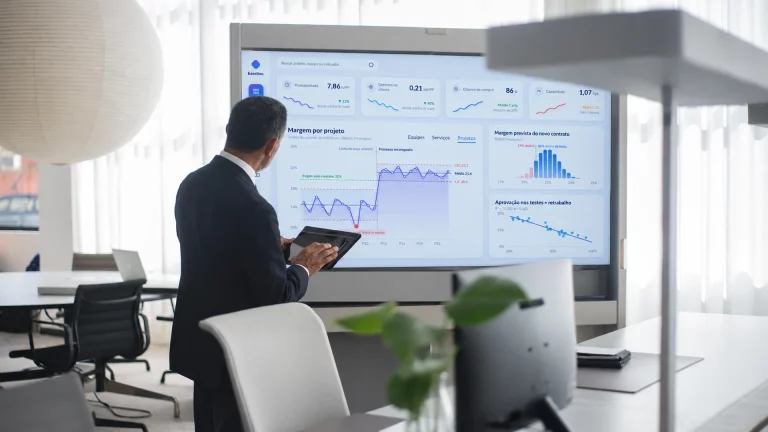
Statistical process control is the set of techniques that measures how a process behaves over time, separating fluctuations...
CMMI AIM (Artificial Intelligence Maturity) is the framework for...



Be the first to comment!