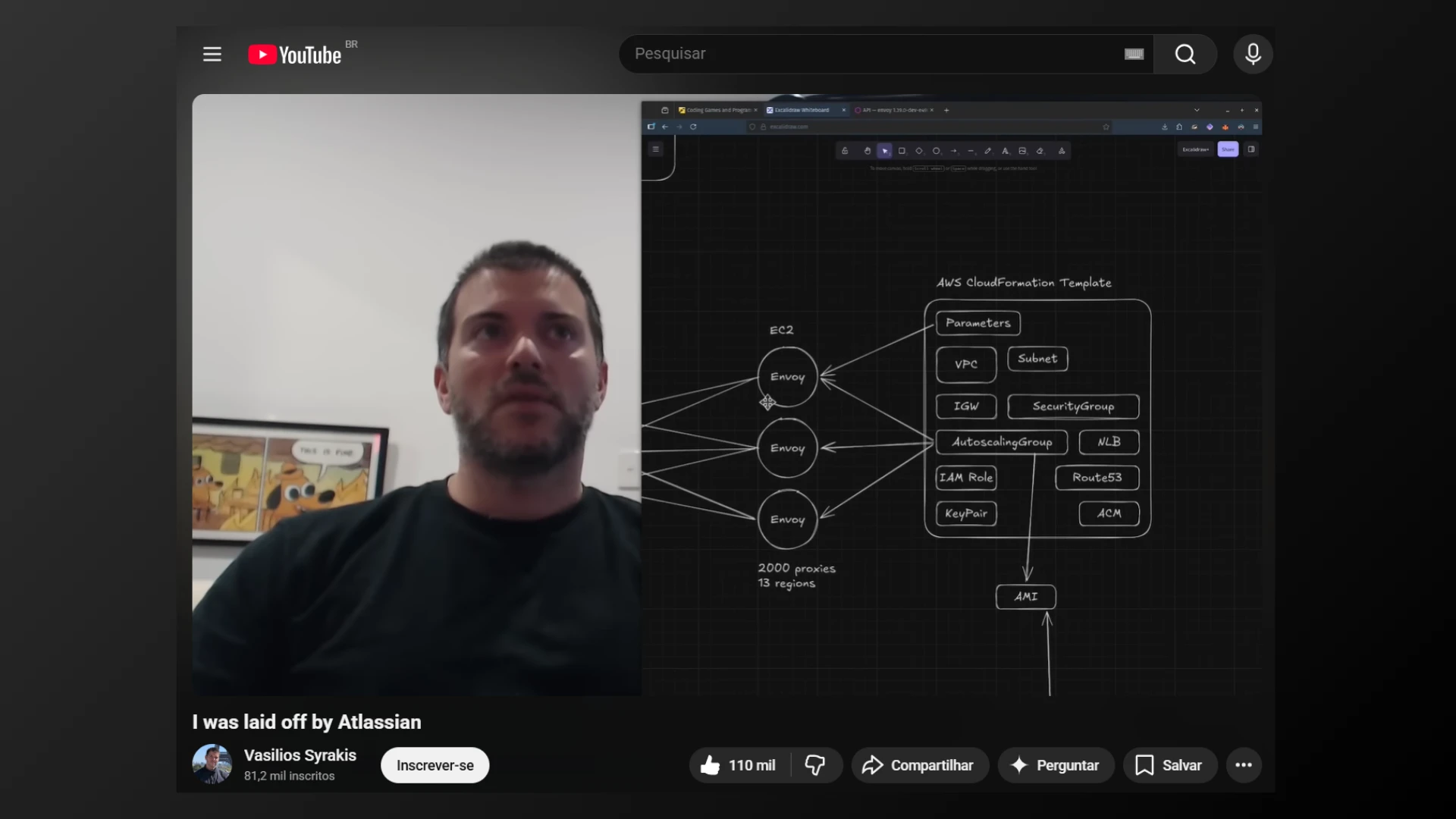
On March 11, 2026, Vasilios Syrakis received the email that many senior engineers have received: eight years at Atlassian, the infrastructure that processes traffic for millions of Jira, Confluence, and Bitbucket users, ended with a standard AI-driven layoff package.
The response was to record a 38-minute video for YouTube.
In eight days, more than 1 million people watched.
Syrakis didn't go on video to complain. He went there to teach.
The video opens with him explaining his intention: “I hope this video will be helpful to someone who is or has been in the same situation as me, and that it will give some inspiration on how to face the same problems I faced, or avoid some of the mistakes I made.”
Next, he spent almost 40 minutes documenting what he had built. The first system was the Open Service Broker: a FastAPI API with an SQS queue and DynamoDB database that allowed teams to provision load balancers autonomously, without opening tickets for operations. The client requests, the worker processes asynchronously, and the database records the state. It was this system that put Jira, Confluence, Bitbucket, and Status Page behind a unified and controlled edge infrastructure.
The second was Sovereign, an Envoy control plane that he himself released as an open-source project. Sovereign dynamically manages proxy configuration templates, rendering routes and listeners in real time without restarting. The practical result: 2,000 proxies in 13 AWS regions, replacing proprietary load balancers with licensing costs. The third system was an authentication sidecar in Rust, which he humorously called "the Lord's language," centralizing authentication and rate limiting for all backend services without each team needing to reimplement these layers. Sovereign is published on PyPI.
If you use Jira, there's a high probability that your traffic has already passed through one of these systems.
The content became a lesson. Technical communities reacted to the video with a mixture of admiration and concern. One phrase circulated in forums and threads: "if this is the caliber of engineer they are firing, something is very wrong."
Atlassian CEO Mike Cannon-Brookes justified the 10% workforce reduction as an “investment in AI.” Five months earlier, in a public statement, he had said the company would hire more engineers, not fewer. The contradiction did not go unnoticed.
But the biggest problem wasn't the contradiction. It was what went out the door along with Syrakis.
In the video, he talks about software maintenance with a clarity that few technical articles achieve: “Building something is easy. Changing it and ensuring that it can continue to be changed over time is difficult. Because as you change things, it becomes progressively harder to change. The parts start to intertwine, and suddenly, when you mess with one area, it affects another, and you need to deal with the work of untangling that.”
And then he makes an observation that seems directed at the current moment in the sector: “It will be interesting to see how we deal with this in vibe coding apps and apps developed with AI. When people aren't really familiar with what they've created, and the burden of maintenance starts to appear.”
This knowledge isn't documented anywhere. It stems from eight years navigating the real complexity of systems that serve millions of users. Institutional knowledge doesn't appear on the balance sheet, it's not listed on the organizational chart, but it exists in every architectural decision that was never documented and in every tacit convention that only makes sense to those who were there when the problem arose.
The most emblematic case involves an employee named Zhou, who worked in quality control for a language modeling company. The company tried to reassign him and cut his salary from 25,000 to 15,000 yuan per month. When he refused, he was fired. The court ruled the dismissal illegal.
The judges' reasoning was straightforward: adopting artificial intelligence is a voluntary strategic decision by the company. The risk of this decision cannot be transferred to the worker. Before laying off employees, companies should prioritize retraining and relocating employees to more advanced roles. "Artificial intelligence should be used to liberate labor, promote employment, and benefit livelihoods," the court stated.
Syrakis' video and the decisions of the Chinese courts speak from opposing angles on the same phenomenon: what happens when companies treat the workforce as a cost to be optimized, not as a source of knowledge to be preserved.
In Atlassian's case, the result was a 38-minute public presentation on critical infrastructure, given by the engineer the company failed to retain. In Zhou's case, it was a court decision that repositioned responsibility: if the company decides to automate, it bears the burden, not the worker.
The issue isn't being against AI. It's recognizing that there's a wealth of technical knowledge that resides within people, which is lost when they leave without transition, and that no code generation tool can recover. A study by the CNI (National Confederation of Industry) indicates that the lack of qualified labor is already the 4th biggest obstacle for Brazilian industry, with 65% of industries feeling a negative impact on maintaining qualified teams. The problem isn't new, but the speed at which we are discarding the people who possess this knowledge is.
At the end of the video, Syrakis talks about what he learned in eight years beyond the technical aspects: diplomacy, conflict resolution, and the ability to transform complex issues into something understandable. "The feedback I received from my colleagues was that I was always available to help and that I could condense complex topics into something comprehensible."
This also goes away when the severance package arrives.
For managers and CTOs, the story raises a practical question: who on your team holds the kind of knowledge that walks out the door with their badge, and is there any real process for mapping this before the need arises? Atlassian handled 1,600 departures with the same standard package, as if the impact of losing the engineer who built the control plane for 2,000 proxies was equivalent to losing any other function.
China is regulating. Big tech companies continue cutting costs. And the market watches 38 minutes of video trying to understand what was lost when that engineer walked out the door.
At Promove, we believe that technology advances best when the people on the team advance along with it. We work with software processes that keep human knowledge at the center, even when everything around us changes. If your company is undergoing changes and wants to strengthen its IT governance with a focus on people, talk to one of our specialists.
Watch the video: I was laid off by Atlassian
Chinese court ruling: Companies cannot fire workers to replace them with AI.

On March 11, 2026, Vasilios Syrakis received the email that many senior engineers have received: eight years at Atlassian, infrastructure...


Be the first to comment!