CMMI (Capability Maturity Model Integration) is a process improvement model that brings together a set of best practices for an organization to assess, structure, and evolve the maturity of its processes. It is maintained by the CMMI Institute, under the management of ISACA, and can be applied by companies in any sector. Learn more on the ISACA website. The current version is CMMI V3.0, published in April 2023, and organizes the evolution of organizations into 5 maturity levels.
In summary, the 5 maturity levels of CMMI are:
By Mariano Montoni, Lead Appraiser CMMI | Published in April 2024 | Updated in July 2026
To centralize operations related to the model (training, professional certifications, and assessments), Carnegie Mellon University created the CMMI Institute in 2012. In 2016, ISACA, the owner of the COBIT model for IT governance, acquired the CMMI Institute, with the challenge of continuously improving the model and globally disseminating the use of CMMI in organizations.
Since then, the model has undergone several versions. The previous version, CMMI v2.0, was published in 2018, and the current version, CMMI v3.0, arrived in April 2023, adding three new domains to the model: Data Management, People Management, and Virtual Work. The model continues to evolve: in 2026, the CMMI Institute published CMMI AIM, an extension that brings CMMI to maturity in the use of artificial intelligence.
A domain is a type of view within CMMI, that is, an area of application of the model. Version 3.0 organizes CMMI into 8 domains, which an organization can adopt individually or in combination. These are:
| Domain | Main focus |
|---|---|
| Development (CMMI-DEV) | Development of products and services |
| Services (CMMI-SVC) | Management and delivery of services |
| Supplier Management (CMMI-SPM) | Supplier selection and management |
| Security | Information security practices in solutions and in the organization. |
| Safety | Physical and operational safety practices |
| Data Management | Data management and quality |
| People Management | Workforce management and development |
| Virtual Work | Managing remote and virtual work |
These domains are not mutually exclusive: a single company can adopt multiple domains simultaneously. For example, a software factory might adopt the Development domain to improve system creation processes and, at the same time, the Services domain to enhance the deployment and support of the delivered systems.
These domains can be used by hardware or software companies, IT service providers, and companies in other areas (such as medical and educational services), as well as organizations that manage suppliers, such as public bodies that outsource systems development and service provision.
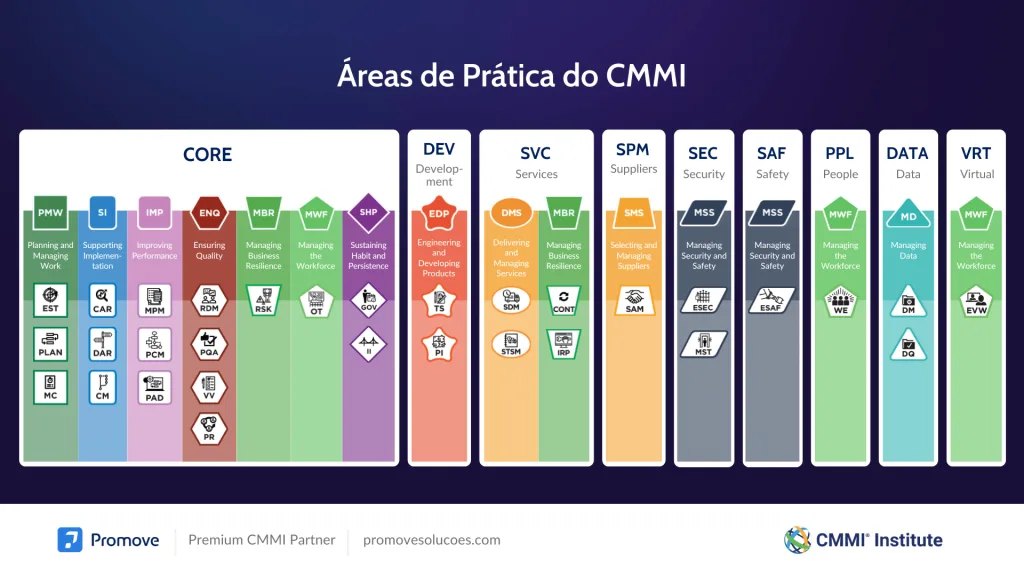
The practices of the CMMI model are grouped into 31 Practice Areas, also called PAs. They are divided into two groups: the core areas (CORE), common to all domains, and the domain-specific areas.

Of the 31 Practice Areas, 17 are part of the core group (CORE), common to all domains. A company wishing to achieve a rating in any domain must meet the requirements of these 17 areas, in addition to those specific to the chosen domain:
The other 14 Practice Areas belong to specific domains. See the main groups:
The same area can serve more than one purpose. The EST (Estimating) area, within the CORE group, for example, helps improve the estimation process for both large development projects and small support and maintenance tasks after the software goes into production.
Related practice areas are grouped into sets called Capability Areas. Each area brings together practices that contribute to a specific type of organizational outcome, forming a coherent roadmap for evolution. Each level of practice group has greater capability than the previous one, as it incorporates more functionality or sophistication.
An example: the set of practice group levels of PA PQA (Process Quality Assurance) includes level 1.1, which identifies and addresses process and work product problems; levels 2.1 to 2.4, which cover the development of a quality plan based on historical data, objective assessments, and communication of results; and level 3.1, which records opportunities for improvement during quality assurance activities.
In CMMI, maturity is the stage of organizational evolution that a company reaches. The model establishes 5 cumulative maturity levels: everything starts at Level 1 and gradually progresses through Levels 2, 3, 4 up to Level 5. To achieve a maturity level in one or more domains, all practice groups of the CORE set of PAs and the domain-specific PAs need to meet the desired level.
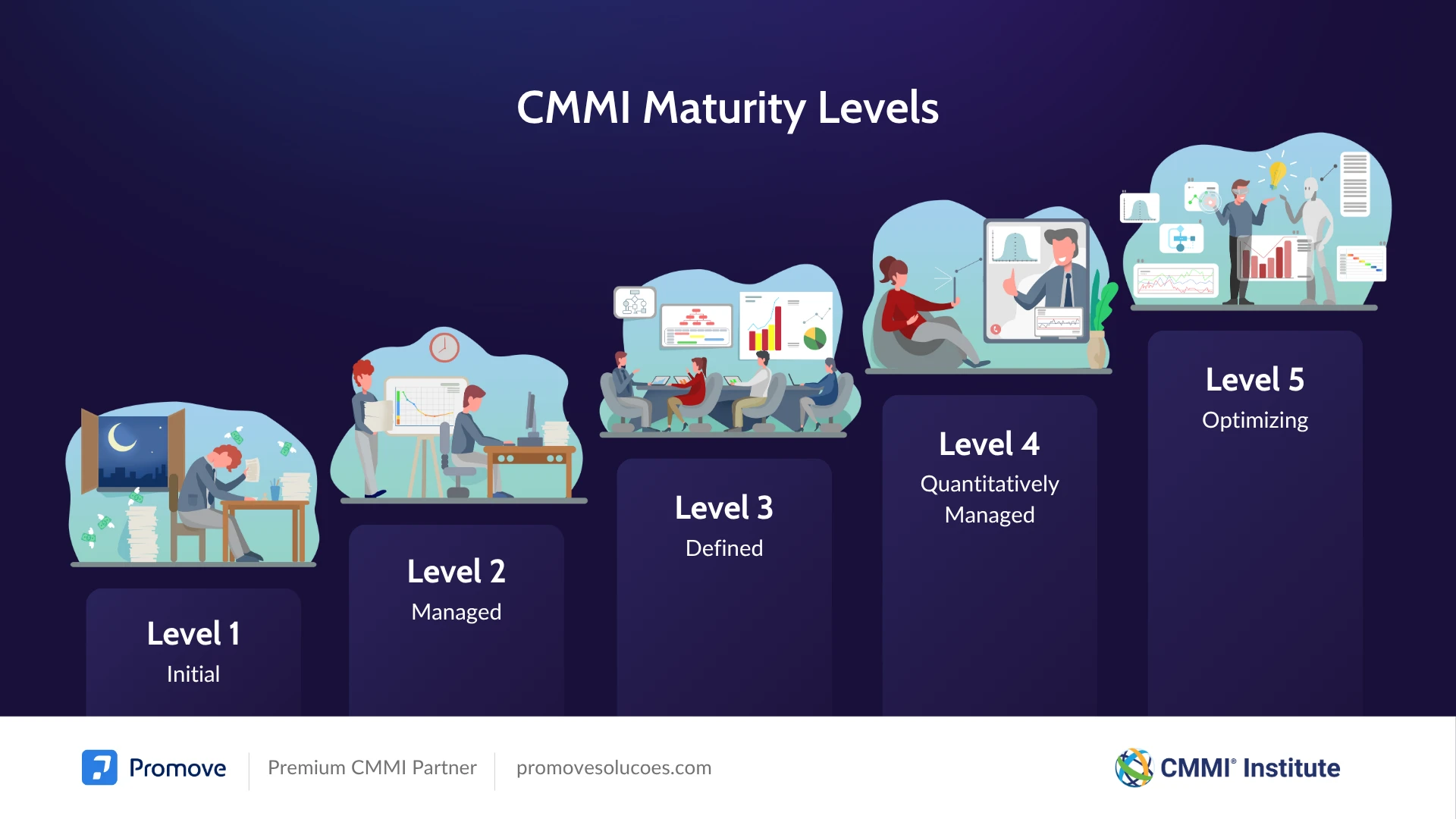
These levels are continuous, from 1 to 5. Based on this roadmap, medium and large companies achieve greater success in their projects and more easily conquer domestic and international markets.
Each of the CMMI maturity levels has scenarios that explain the benefits of reaching that stage, in the complete CMMI maturity level guide. Promove also offers a free self-assessment to help you identify your company's needs towards quality certifications such as CMMI and MPS.BR.
Capability is the set of knowledge, skills, and proficiencies of an organization, typically present in its people, processes, infrastructure, and technology. It is what the company needs to execute its business model, fulfill its mission, and achieve measurable results. With increased capability, an increase in process performance is expected.
CMMI capability levels range from level 1 to level 5. For a Practice Area to reach a given capability level, all practice groups in that area must reach the intended level, as well as the practice groups in areas II (Implementation Infrastructure) and GOV (Governance).
CMMI is increasingly used by IT professionals because it generates direct benefits for both systems development and company credibility. Among the main advantages are:
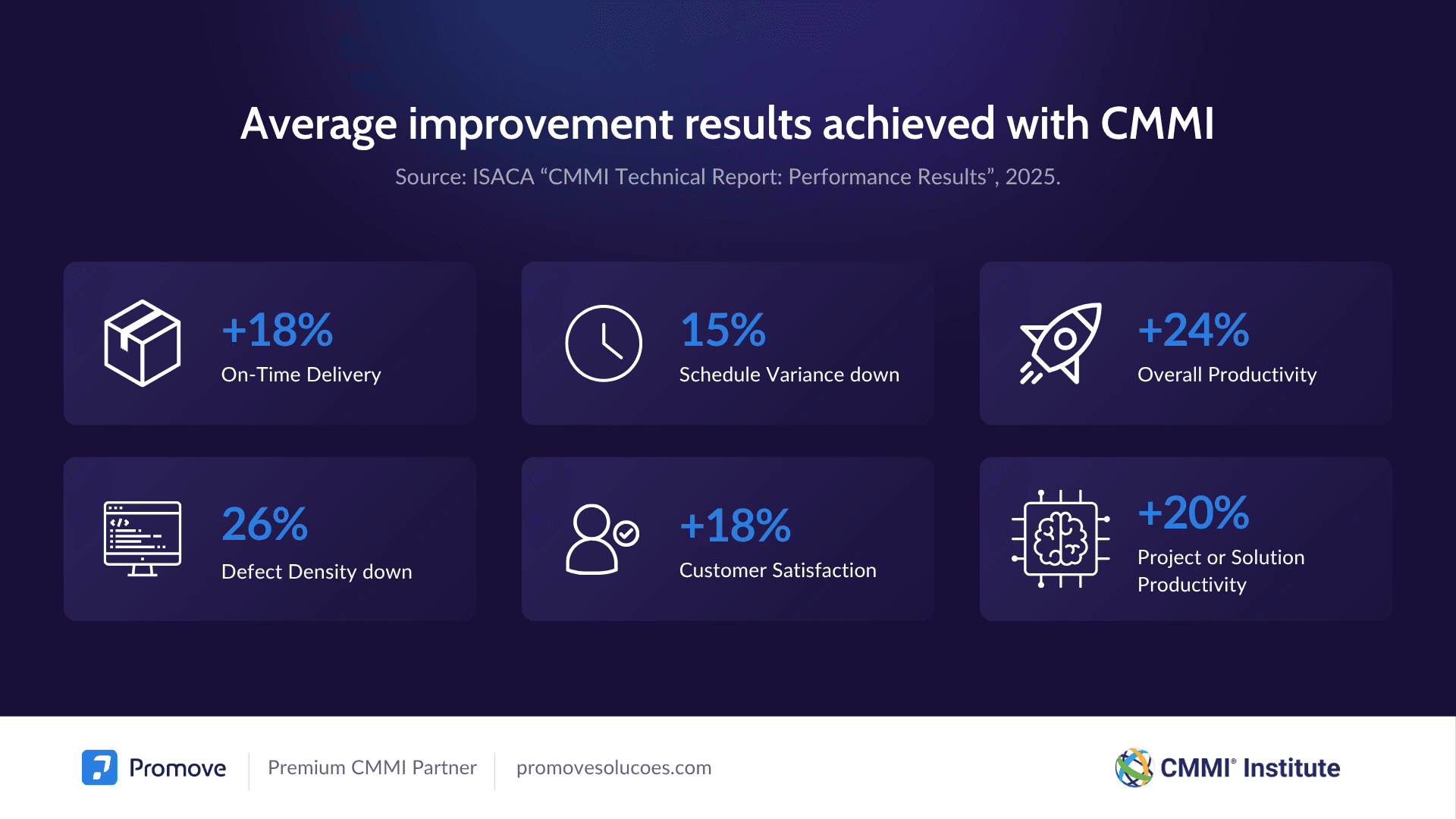
The results are measurable. According to the ISACA Technical Performance Report (CMMI Technical Report: Performance Results, 2025), organizations that adopt CMMI register, on average, a 26% reduction in defect rate, a 24% increase in overall productivity, and an 18% increase in customer satisfaction.
Beyond process gains, CMMI translates into business results. Task distribution becomes clearer and more productive, leading to cost savings and more integrated teams. Leaders gain control over projects, with greater predictability of deadlines and budgets and fewer surprises along the way.
With mature processes, the company diagnoses problems earlier, delivers software that better meets customer needs, and gains greater market relevance. This recognition opens doors in tenders, international contracts, and partnerships that require proof of quality, while also improving the internal climate and helping to retain talent. See also the benefits achieved by Brazilian companies with CMMI certification.
To delve deeper into the model, watch the introductory lessons on Promove's YouTube channel and the playlist of webinars led by our experts Mariano Montoni and David Zanetti, both certified as CMMI Lead Appraisers:
See also how CMMI integrates with Scrum, Kanban, and DevSecOps.
In a CMMI appraisal, the company is analyzed by a Lead Appraiser certified by ISACA, following the official method defined in the CMMI Method Definition Document (MDD). The appraiser compares the organization's processes with the model's practices and assigns an official maturity level or capability score, recognized internationally.
The method defines four types of appraisal: Benchmark, a formal appraisal that generates the official level result, valid for 3 years; Sustainment, which renews this result for periods of 2 years; Evaluation, more flexible, used to measure progress towards the desired level; and Action Plan Reappraisal, a second chance when the organization narrowly misses the intended level in a Benchmark or Sustainment appraisal, with a 4-month deadline to redo the appraisal.
The official results are published on ISACA's public appraisal system (PARS, Published Appraisal Results), which allows any client or partner to verify the certification of the company being assessed.
Promove accompanies you throughout this entire process, from the initial diagnosis to the final appraisal. With certified Lead Appraisers and experience in companies of different sizes, the consultancy helps structure processes, prepare the team, and conduct the appraisal with confidence. Talk to a Promove specialist in process improvement and discover how to begin your company's CMMI journey.


Statistical process control is the set of techniques that measures how a process behaves over time, separating fluctuations...
CMMI AIM (Artificial Intelligence Maturity) is the framework for...



Be the first to comment!