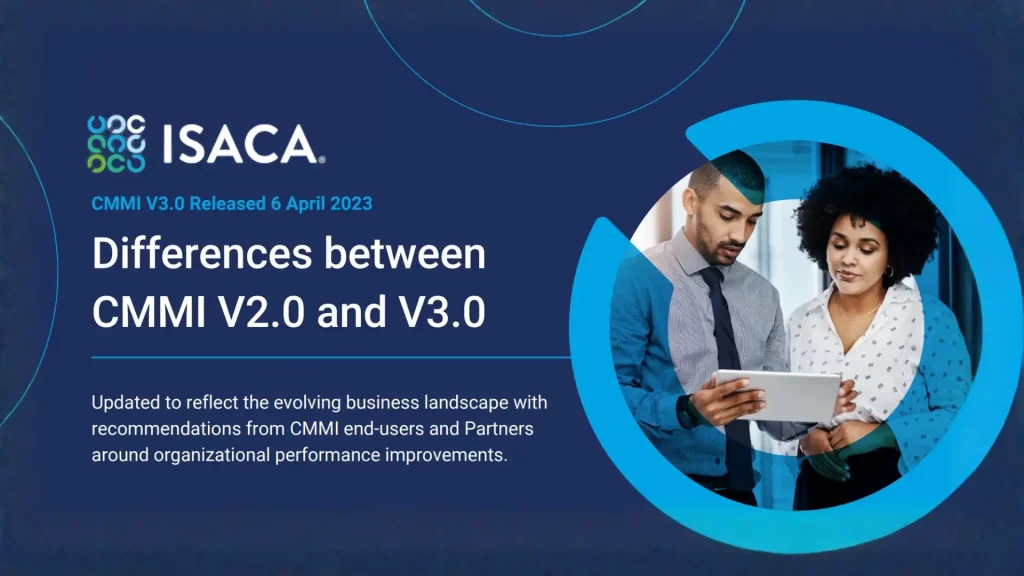
CMMI version 3.0 is the current edition of the CMMI Institute's performance improvement model, published in April 2023. The model can be applied to product development, services, and IT operations, and organizes practices into Domains, Capability Areas, and Practice Areas to help companies increase quality, predictability, and business outcomes at scale.
This article is for those who are already familiar with the model and want to understand what has changed. If you are new to the subject, start with the CMMI guide: what it is and how to use it. And if you want to review the previous version, now superseded by this one, see the article on CMMI 2.0.
CMMI stands for Capability Maturity Model Integration: a set of best practices that serve as a reference for companies in various sectors to increase the maturity of their process performance. Version 3.0 expanded knowledge of industry best practices beyond product development, service operation, and supplier management, covering eight domains:
With the new version, organizations can establish more comprehensive and effective process improvement programs to help achieve business objectives. The practices continue to be organized into 5 practice levels, from initial to optimized, following the same logic as the CMMI maturity levels: the higher levels use statistical and quantitative techniques to understand performance variation and optimize results. See the complete guide to CMMI maturity levels. It's the difference between deciding based on statistical evidence and deciding based on simple averages, which hide the real variability of the process.
This organization of practices didn't happen by chance. CMMI drew from industrial sources: from Toyota's practices, such as Jidoka and Just-in-Time, and from Deming's work with the PDCA cycle and statistical process control. Understanding this origin helps in interpreting version 3.0: the reinforcement of the Plan, Measure, Improve, and Govern cycle is the same logic of continuous improvement used in manufacturing, applied to software and services.
In CMMI version 3.0, new Practice Areas were included in the model: Data Management, Data Quality, Workforce Empowerment, Enabling Security, Managing Security Threats and Vulnerabilities and Enabling Safety, in addition to the update of Enabling Virtual Work. The new Managing Data Capability Area has also been added, helping to use and process business-related data to obtain reliable, accurate data, useful for decision-making to achieve desired performance results.
A practical scenario illustrates the importance of this addition. Consider a company that needs to decide whether to take on a contract with an aggressive deadline and margin target. If the historical project performance data is incomplete or lacks quality criteria, any estimate becomes a gamble. With structured Data Management and Data Quality practices, the decision is based on complete and comparable data: the company knows what its process is capable of delivering before signing the contract, not after.
| Domain | Changes in CMMI version 3.0 |
|---|---|
| Data (DATA) | Inclusion of Practice Areas Data Management (DM) and Data Quality (DQ) |
| Security (SEC) | New Practice Areas: Enabling Security (ESEC) and Managing Security Threats & Vulnerabilities (MST) |
| Safety (SAF) | New Practice Area: Enabling Safety (ESAF) |
| People (PPL) | Creation of the Capability Area Workforce Empowerment (WE)which also includes Organizational Training (OT) already in place since the last model update |
| Virtual (VRT) | Practice Area Update Enabling Virtual Work (EVW) |
| Services (SVC) | The Capability Area remains Delivering and Managing Services (DMS) containing the Practice Areas Service Delivery Management (SDM) and Strategic Service Management (STSM) |
| Suppliers (SPM) | The Practice Area Supplier Source Selection (SSS) was discontinued and integrated into Supplier Agreement Management (SAM) |
| Development (DEV) | The Capability Area remains Engineering and Developing Products (EDP) containing the Practice Areas Technical Solution (TS) and Product Integration (PI) |
| Core | Strengthening the Plan, Measure, Improve, and Govern cycle (PQA, MPM, RDM, VV; EST, PLAN, MC; PAD, PCM; GOV) |
ISACA, the organization responsible for the CMMI Institute, explains that the update was made to keep the model's content aligned with current industry needs and practices, such as DevSecOps and updates on agile methodologies. See the official ISACA announcement.
The changes in CMMI version 3.0 do not significantly impact companies that already have processes compliant with CMMI 2.0. The biggest changes are related to the addition of new Practice Areas and a new Capability Area, which do not affect the practices established in previous versions of the model. In practice, this means that the investment made in the previous version is preserved: the organization evolves to version 3.0 from the process base it has already structured.
For organizations, CMMI makes it more direct to connect execution to results. And for professionals, the path of official certifications (CMMI Associate, Practitioner, Professional) reinforces employability and technical authority in adopting and evaluating the model. By domain, the practical effect of the changes is this:
The new practices of CMMI version 3.0 are mainly related to data management, security, and protection. These knowledge areas were added to the model to consider the evolving business landscape, and in Brazil this has a direct consequence: organizations that have processes adhering to the Data, Security, and Safety domains of CMMI version 3.0 are closer to achieving compliance with the requirements of the General Data Protection Law (LGPD).
The logic is simple: the LGPD (Brazilian General Data Protection Law) requires demonstrable controls over the data lifecycle, and the Data and Security domains of CMMI structure exactly that, with traceability, quality criteria, and continuous threat management. Instead of building a separate compliance framework, the company builds the controls within its own process, with evidence that is already ready for auditing.
Yes. Version 3.0 contains guidance on how to apply the practices in agile development environments that use Scrum or Kanban, and also provides information for teams that adopt DevSecOps. CMMI supports continuous improvement cycles and the iterative definition of goals, which makes the agile process more sustainable and scalable.
This dispels a common misconception in the market: CMMI does not compete with agility; it dictates what to do, not how. A team can run Scrum and, at the same time, use CMMI practices as a benchmark to measure whether the process is delivering the results the business needs.
See how to integrate CMMI with agile methodologies in practice.
Decisions are made faster because the data is reliable and comparable across departments. Compliance with laws and contracts happens more naturally because controls and evidence are built into the process from the start.
In development, connections between systems and services for exchanging data or triggering actions and deliveries become more predictable. There is less "rollback," that is, less need to undo a version and revert to the previous one when something goes wrong after publication. Clear acceptance criteria and earlier testing reduce this "back and forth" to production. Security is always active, with prevention and response integrated into the routine, which reduces the impact and recurrence of incidents.
Management improves with estimates that more closely reflect the actual capacity of teams, stable service levels, and more predictable costs. Suppliers are monitored using the same indicators as internal teams, quality is maintained across teams, and audits become simpler. In short, the organization gains speed with more preventative controls.
CMMI version 3.0 translates current trends into practice: data, security in all phases of the project, distributed work, and even artificial intelligence. In this last area, the CMMI Institute launched CMMI AIM in 2026, an extension of the model dedicated to AI governance, built on the same 8 domains as version 3.0.
It's worth remembering what experience with the model teaches us: implementing CMMI is not a project with an end date; it's an ongoing review of processes in pursuit of optimization, with decisions supported by data, not intuition. If your organization seeks predictability, compliance, and scale, it's worth investing in a well-done diagnosis and starting with the areas where there are the most gaps.
Count on Promove to conquer the market. We have over 15 years of experience in improving software development processes based on CMMI, MPS, ISO, Agile, and DevOps. Get in touch!

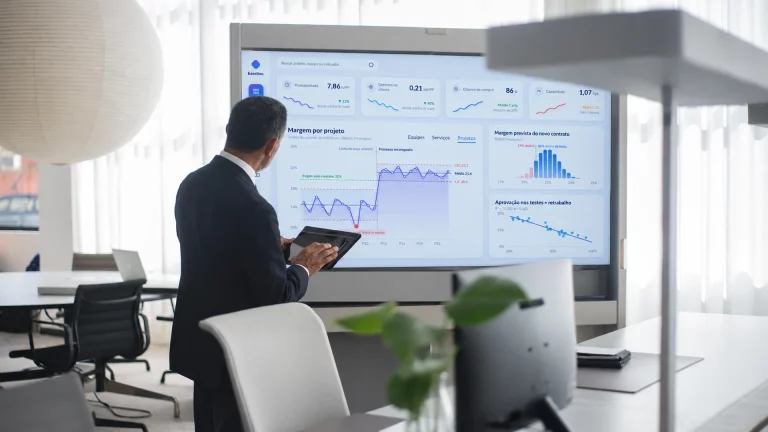
Statistical process control is the set of techniques that measures how a process behaves over time, separating fluctuations...
CMMI AIM (Artificial Intelligence Maturity) is the framework for...



Be the first to comment!