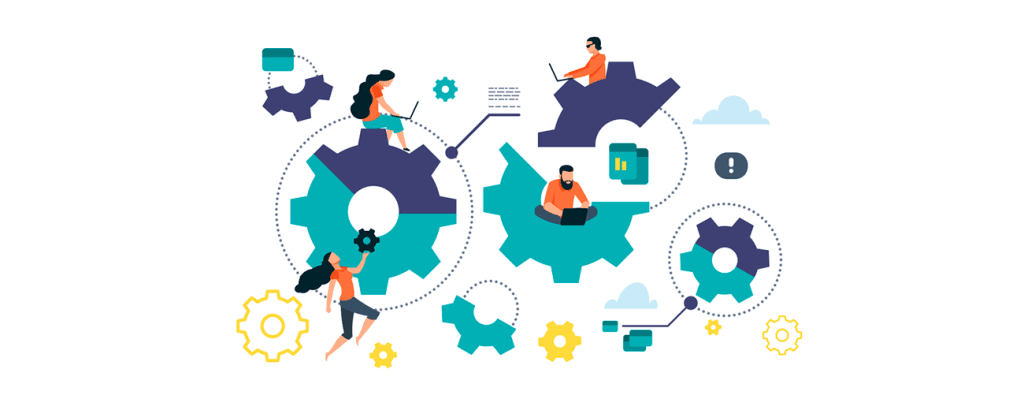
When we talk about remote or hybrid work, this idea is automatically associated with the benefits of a home office, the flexibility gained by working from home, and the freedom it provides. What is not seen is that this is just a small drop in the ocean.
Working with distributed teams means embracing a series of new habits, practices, and technologies that facilitate communication, strengthen project visibility, and impact individual productivity.
Fortunately, if your company isn't currently working remotely, these practices can continue to help you build stronger, more connected teams, even in person.
In this article, we'll discuss 7 strategies that can be adopted to create more connected, continuous, and engaged teams in remote or hybrid work.
Who has never experienced that moment when their concentration is super high while carrying out some activity and, suddenly, a bunch of messages arrive from a colleague requesting some information, asking about some part of the project or simply making conversation?
When faced with these corporate situations, we come to the conclusion that immediacy and instant communication, in many situations, are not good allies of productivity.
Therefore, it is necessary to adopt some less instantaneous and more protected means of communication.
Asynchronous communication is respectful, empathetic, and promotes productivity. Interaction is available to continue at the best possible time, respecting each person's boundaries and space.
Frequent alignments are necessary to understand how and what is happening in the project progress.
It's not a good idea to plan meetings without preparation and a clear objective. It's crucial that these meetings be short, to the point, and always clearly focused.
Methodologies like these save time and bring efficiency to even the most complex situations.
Emails aren't ideal for gathering and providing context for a conversation, nor for following the discussion in a structured and organized way. It's easy for the conversation to stray at some point. If someone isn't properly connected, it can cause a series of communication interruptions.
Use a tool that structures and allows anyone who wants to join the discussion to understand where it started and how the topic progressed. A good tool for this is Slack.
Having many people on a project makes communication within and outside the team very complex. A great strategy to mitigate this is to break a large group into subgroups, keeping a few people working closely and highly aligned around the established tasks.
As the project progresses, progress is made available to other teams in the form of updates. This ensures and focuses agility in decision-making.
It's amazing to have co-creation sessions and generate ideas as a group. Collaborative work is incredibly rewarding, and it's from these committees that great solutions emerge.
Taking this to the online corporate environment, it's essential to have everything written down/documented for reference, collaboration, and, most importantly, for continuity. This also applies to text reviews, visual projects, and other activities.
Although we're all conditioned to follow "business" hours, there's a huge disparity in our daily routines. Each person has a different life context, environment, and habits specific to their identity.
Believing this allows people to be more fulfilled in their work environment and have the freedom to take control of their own lives. This results in many benefits within a corporation and results in much higher, less forced productivity.
Give people the freedom to invest in their best selves in whatever way they choose. Give them autonomy and flexibility so they can put this into practice. Set goals and challenges instead of assigning tasks!
People are more motivated to participate in work they develop themselves. Autonomy only works when accompanied by strong alignment, so that we're truly moving in the same direction.
All of these strategies pertain to remote work, but they can also be applied to in-office teams, resulting in visible benefits from adopting this way of working. Thus, with these practices established, the company will have no problem on a day when someone, for whatever reason, cannot be in the office.
The environment becomes more dynamic as the office no longer ends at the limits of that wall, but has already gained a timeless and non-geographic dimension.
By following these practices, you and your team are likely already working remotely, but without leaving the office. Diving into the distributed world will simply be a matter of choice.
Think of all this as an opportunity to acquire strategies for your business!
Did you enjoy our content? Also read Home Office! How to work from home without losing productivity?

Statistical process control is the set of techniques that measures how a process behaves over time, separating fluctuations...

CMMI AIM (Artificial Intelligence Maturity) is the framework for...



Be the first to comment!